- Mohammed Ali Road, Mumbai, Maharashtra 400003, India.



ASTM A387 Grade 91 Sheet Plate, Coil Supplier in Mumbai
- Home
- Products
- Sheets, Plates & Coils
- Alloy Steel Sheets, Plates & Coils Supplier in Mumbai, India
- ASTM A387 Grade 91 Sheet Plate, Coil Supplier in Mumbai
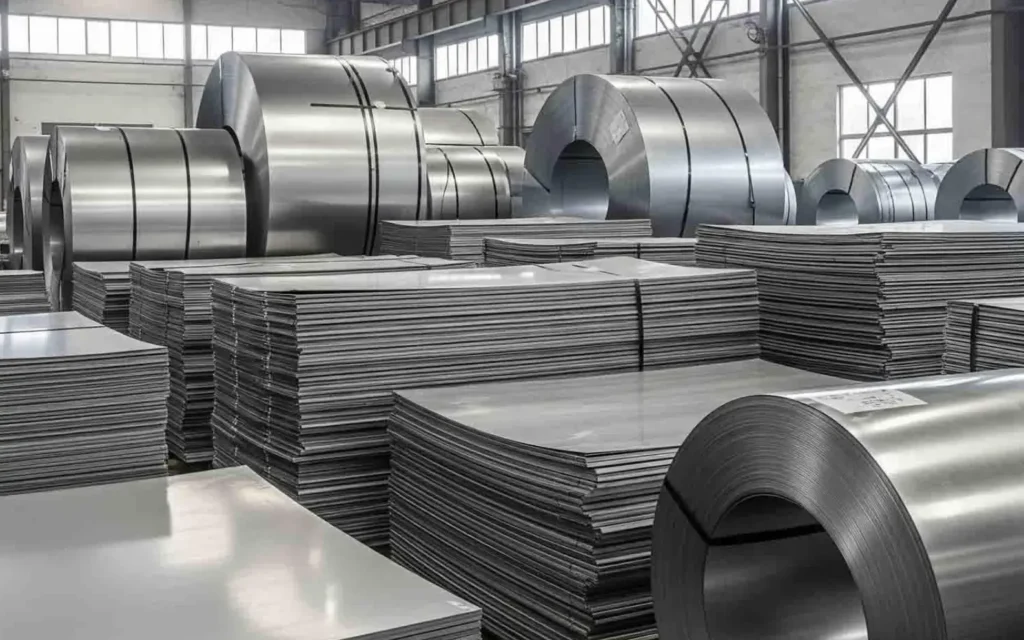
- ASTM A387 Grade 91 Sheet Plate, Coil Overview
- Types of ASTM A387 Grade 91 Sheet Plate, Coil
- ASTM A387 Grade 91 Sheet Plate, Coil Specifications
- ASTM A387 Grade 91 Sheet Plate, Coil Chemical Composition
- ASTM A387 Grade 91 Sheet Plate, Coil Mechanical Properties
- ASTM A387 Grade 91 Sheet Plate, Coil Equivalent Grades
- ASTM A387 Grade 91 Sheet Plate, Coil Applications
- Why Choose Metals Fabrica for ASTM A387 Grade 91 Plate?
- ASTM A387 Grade 91 Sheet Plate, Coil FAQs
- Request a Quote for ASTM A387 Grade 91 Sheet Plate, Coil
ASTM A387 Grade 91 Sheet Plate, Coil Overview
ASTM A387 Grade 91 (UNS K90901) is a creep-strength-enhanced ferritic steel based on 9Cr-1Mo, with controlled additions of vanadium (0.18–0.25%), niobium (0.06–0.10%) and nitrogen (0.030–0.070%). After normalising at 1040–1080 °C and tempering at 730–800 °C it develops a tempered martensite structure strengthened by fine vanadium and niobium carbonitrides. The result is creep-rupture strength well above that of Grade 22 or conventional Grade 9, which allows thinner walls at steam temperatures around 550–600 °C.
Unlike the other A387 grades, Grade 91 is supplied in Class 2 only, with a 585–760 MPa tensile range and a 415 MPa minimum yield. Its properties depend on correct heat treatment, so specifications commonly add hardness limits on the plate, controls on residual elements such as nickel and aluminium, and strict preheat, interpass and post-weld heat-treatment rules for fabrication. Recent editions of A387 also distinguish Type 1 and Type 2 chemistry, with Type 2 carrying tighter residual limits.
Metals Fabrica supplies Grade 91 plate, sheet and coil and confirms the type, hardness range and test requirements on your specification so the plate suits your welding and PWHT procedures.
- Standard: ASTM A387 / ASME SA387 Grade 91, Class 2
- Heat treatment: normalised 1040–1080 °C, tempered 730–800 °C
- Microstructure: tempered martensite with V and Nb carbonitrides
- Matching products: A335 P91 pipe, WP91 fittings and F91 flanges
Types of ASTM A387 Grade 91 Sheet Plate, Coil
A387 Grade 91 Class 2 Plate
The single strength level for Grade 91: 585–760 MPa tensile and 415 MPa minimum yield after normalising and tempering, used for creep-governed pressure parts.
Grade 91 Type 1 and Type 2 Plate
Type 2 chemistry tightens residual elements such as nickel, copper, aluminium and titanium and controls the nitrogen-to-aluminium ratio for improved long-term creep performance.
Grade 91 Plate with Hardness Limits
Plate tested for hardness across the surface to confirm correct tempering, since both under- and over-tempered Grade 91 lose creep strength.
Grade 91 Plate with Simulated PWHT
Coupons tested after a simulated post-weld heat treatment to show that strength remains within the Class 2 range after fabrication cycles.
Grade 91 Sheet and Thin Plate
Thinner gauges for liners, baffles and formed parts in HRSG and boiler assemblies that must match the creep behaviour of the main components.
ASTM A387 Grade 91 Sheet Plate, Coil Specifications
| Specification | Details |
|---|---|
| Standard | ASTM A387 / ASME SA387 Grade 91, Class 2 |
| UNS | K90901 |
| General requirements | ASTM A20 / ASME SA20 |
| Thickness | Sheet 0.3–6 mm; plate 6–150 mm and above |
| Width | 1000, 1219, 1500, 2000, 2500 mm and to order |
| Length | 2000, 2500, 3000, 6000 mm, coils and cut to size |
| Heat treatment | Normalised 1040–1080 °C (1900–1975 °F) and tempered 730–800 °C (1350–1470 °F) |
| Surface condition | Hot rolled, normalised and tempered; shot blasted or pickled on request |
| Forms | Sheet, plate, coil, strip, cut-to-size blanks, circles |
| Testing | Tension test per ASTM A20; hardness survey, ultrasonic testing, Charpy impact, simulated PWHT and PMI on request |
| Documentation | EN 10204 3.1 mill test certificate; EN 10204 3.2 on request |
State Type 1 or Type 2, hardness limits and simulated PWHT cycle in your enquiry.
ASTM A387 Grade 91 Sheet Plate, Coil Chemical Composition
Base Elements
| Grade | UNS | C | Mn | P | S | Si | Cr | Mo |
|---|---|---|---|---|---|---|---|---|
| Grade 91 | K90901 | 0.08 – 0.12 | 0.30 – 0.60 | 0.020 | 0.010 | 0.20 – 0.50 | 8.00 – 9.50 | 0.85 – 1.05 |
Micro-Alloying and Residual Elements
| Grade | V | Nb | N | Ni | Al | Ti | Zr |
|---|---|---|---|---|---|---|---|
| Grade 91 | 0.18 – 0.25 | 0.06 – 0.10 | 0.030 – 0.070 | 0.40 | 0.02 | 0.01 | 0.01 |
Grade 91 Type 2 carries tighter limits on residual elements; check the current edition of A387 when Type 2 is specified.
ASTM A387 Grade 91 Sheet Plate, Coil Mechanical Properties
| Grade | Class | Density | Tensile Strength | Yield Strength (0.2% Offset), min | Elongation in 50 mm, min |
|---|---|---|---|---|---|
| Grade 91 | Class 2 | 7.77 g/cm³ | 585 – 760 MPa (85 – 110 ksi) | 415 MPa (60 ksi) | 18% |
Density is a typical value, not a specification requirement. Grade 91 is not produced in Class 1.
ASTM A387 Grade 91 Sheet Plate, Coil Equivalent Grades
| Grade | UNS | EN / DIN | JIS | BS | GB |
|---|---|---|---|---|---|
| A387 Grade 91 | K90901 | X10CrMoVNb9-1 (1.4903) | SCMV 28 | – | – |
Equivalents are approximate; residual-element limits and tempering ranges differ between EN 10028-2, JIS G4109 and A387. Order to the standard named in your specification.
ASTM A387 Grade 91 Sheet Plate, Coil Applications
Supercritical and Ultra-Supercritical Boilers
Headers, separators and pressure parts in high-temperature steam circuits, where Grade 91 creep strength reduces wall thickness and thermal fatigue.
Heat Recovery Steam Generators
HRSG components in combined-cycle plants that see frequent start-stop cycling, where thinner Grade 91 sections lower thermal stresses.
Steam Turbine and Valve Components
Plate for casings, chests and fabricated parts exposed to main steam temperatures that exceed the useful creep range of Grade 22.
Refinery and Petrochemical Heaters
Pressure parts in high-temperature hydrocarbon service where both creep strength and the corrosion resistance of 9% chromium are needed.
Why Choose Metals Fabrica for ASTM A387 Grade 91 Plate?
- Type and residuals confirmed: we check whether your specification calls for Type 1 or Type 2 chemistry before quoting.
- Heat treatment documented: normalising and tempering temperatures and hardness results requested on the mill certificate.
- Grade 91 system supply: plate quoted with P91 pipe, WP91 fittings and F91 flanges.
- Verification support: PMI for vanadium and niobium and third-party inspection coordinated when your order requires it.
ASTM A387 Grade 91 Sheet Plate, Coil FAQs
Why is A387 Grade 91 only available in Class 2?
Grade 91 gets its strength from a normalised and tempered martensitic structure, so ASTM A387 defines a single strength level for it. That level, 585–760 MPa tensile and 415 MPa yield, is designated Class 2.
Is A387 Grade 91 plate the same material as P91 pipe?
Both are modified 9Cr-1Mo-V steels with very similar chemistry and heat treatment. A387 Grade 91 covers plate and A335 P91 covers seamless pipe, so components are ordered to the product standard for each form.
Why is hardness checked on Grade 91 plate?
Hardness confirms that normalising and tempering were done correctly. Plate that is too hard may be under-tempered and crack during fabrication, while plate that is too soft may have lost creep strength.
What welding precautions apply to Grade 91?
Grade 91 requires preheat, controlled interpass temperature and post-weld heat treatment within a narrow temperature range, using matching consumables such as AWS A5.5 E9018-B9. Procedures must be qualified to the governing code.
What is the difference between Grade 91 Type 1 and Type 2?
Type 2 adds tighter limits on residual elements such as nickel, copper, aluminium and titanium and controls the nitrogen-to-aluminium ratio. It is specified where long-term creep performance must be maximised.