- Mohammed Ali Road, Mumbai, Maharashtra 400003, India.



ASTM A387 Grade 22 Sheet Plate, Coil Supplier in Mumbai
- Home
- Products
- Sheets, Plates & Coils
- Alloy Steel Sheets, Plates & Coils Supplier in Mumbai, India
- ASTM A387 Grade 22 Sheet Plate, Coil Supplier in Mumbai
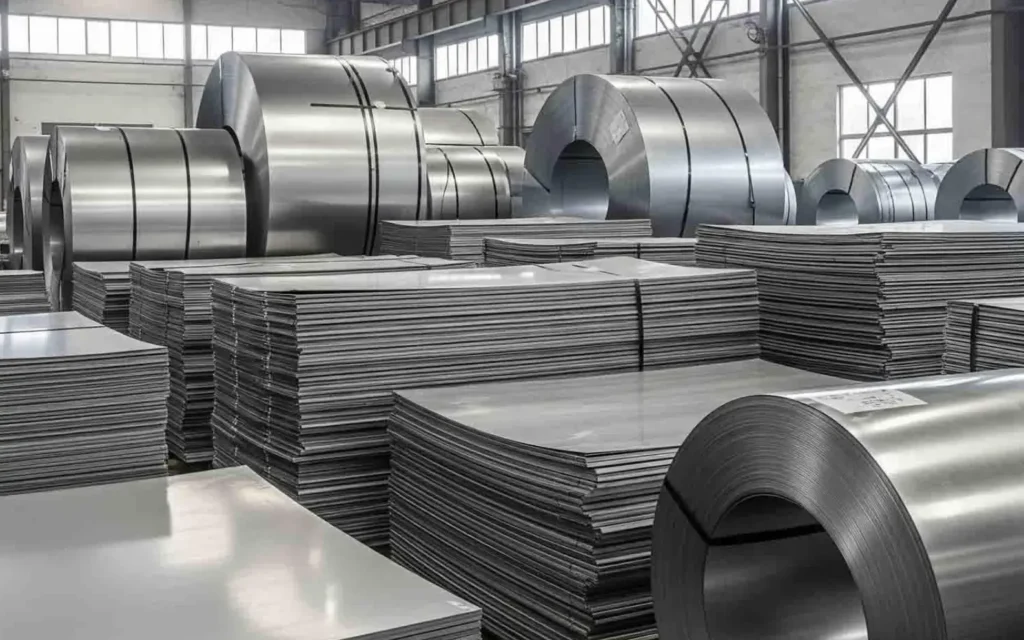
- ASTM A387 Grade 22 Sheet Plate, Coil Overview
- Types of ASTM A387 Grade 22 Sheet Plate, Coil
- ASTM A387 Grade 22 Sheet Plate, Coil Specifications
- ASTM A387 Grade 22 Sheet Plate, Coil Chemical Composition
- ASTM A387 Grade 22 Sheet Plate, Coil Mechanical Properties
- ASTM A387 Grade 22 Sheet Plate, Coil Equivalent Grades
- ASTM A387 Grade 22 Sheet Plate, Coil Applications
- Why Choose Metals Fabrica for ASTM A387 Grade 22 Plate?
- ASTM A387 Grade 22 Sheet Plate, Coil FAQs
- Request a Quote for ASTM A387 Grade 22 Sheet Plate, Coil
ASTM A387 Grade 22 Sheet Plate, Coil Overview
ASTM A387 Grade 22 (UNS K21590) is the 2¼% chromium, 1% molybdenum plate steel, with 2.00–2.50% chromium, 0.90–1.10% molybdenum, 0.05–0.15% carbon and silicon limited to 0.50%. Doubling the molybdenum of Grades 2 and 11 gives a clear gain in creep-rupture strength, and the higher chromium improves resistance to high-temperature hydrogen attack. These properties make Grade 22 Class 2 the reference material for thick-walled hydrotreater and hydrocracker reactors.
Class 1 plate has a 415–585 MPa tensile range and 205 MPa yield; Class 2, normalised and tempered or quenched and tempered, requires 515–690 MPa and 310 MPa. Heavy reactor plate is usually ordered with extra controls beyond A387: simulated PWHT, Charpy testing after step cooling, and limits on the J-factor and X-bar values to reduce temper embrittlement, often following API RP 934-A. A low-carbon variant, Grade 22L, is also listed in A387, while vanadium-modified 2¼Cr-1Mo-¼V plate is ordered to ASTM A542 or A832 instead.
Compared with Grade 11, Grade 22 is chosen for higher temperature or hydrogen partial pressure; for severe sulphidation, Grade 5 may be preferred. Metals Fabrica supplies Grade 22 plate, sheet and coil and reviews every supplementary requirement on your reactor or vessel specification.
- Standard: ASTM A387 / ASME SA387 Grade 22, Class 1 and Class 2
- Nominal alloy: 2¼% chromium, 1% molybdenum
- Typical extra controls: step cooling, J-factor and X-bar limits, simulated PWHT
- Matching products: A335 P22 pipe, WP22 fittings and F22 flanges
Types of ASTM A387 Grade 22 Sheet Plate, Coil
A387 Grade 22 Class 1 Plate
Tensile range 415–585 MPa and 205 MPa minimum yield. Used for lower-stress vessels and components where softer, more formable plate is preferred.
A387 Grade 22 Class 2 Plate
Normalised and tempered or quenched and tempered to 515–690 MPa tensile and 310 MPa yield, the usual class for reactors and high-pressure vessels.
Grade 22 Reactor Plate with Step Cooling
Heavy plate with Charpy tests before and after a step-cooling cycle, plus J-factor and X-bar chemistry limits to control temper embrittlement.
A387 Grade 22L Plate
Low-carbon variant with carbon limited to 0.10%, supplied annealed, for applications where lower hardness and improved weldability are specified.
Grade 22 Sheet and Coil
Thinner 2¼Cr-1Mo gauges for internals, shrouds and formed parts that must match the chemistry and creep behaviour of the main pressure shell.
Grade 22 Tube Sheet and Head Blanks
Thick circles and rectangles cut from certified plate for exchanger tube sheets, reactor heads and nozzle reinforcement, with the heat number kept on each piece.
ASTM A387 Grade 22 Sheet Plate, Coil Specifications
| Specification | Details |
|---|---|
| Standard | ASTM A387 / ASME SA387 Grade 22 and 22L; Class 1 and Class 2 (Grade 22) |
| UNS | K21590 |
| General requirements | ASTM A20 / ASME SA20 |
| Thickness | Sheet 0.3–6 mm; plate 6–150 mm and above |
| Width | 1000, 1219, 1500, 2000, 2500 mm and to order |
| Length | 2000, 2500, 3000, 6000 mm, coils and cut to size |
| Heat treatment | Annealed, normalised and tempered, or quenched and tempered; tempering 675 °C (1250 °F) minimum |
| Surface condition | Hot rolled and heat treated; shot blasted or pickled on request |
| Forms | Sheet, plate, coil, strip, cut-to-size blanks, circles |
| Testing | Tension test per ASTM A20 including reduction of area; ultrasonic testing (A435 / A578), Charpy impact, step cooling, simulated PWHT, hardness and PMI on request |
| Documentation | EN 10204 3.1 mill test certificate; EN 10204 3.2 on request |
For hydrogen service, list step-cooling, J-factor, X-bar and simulated PWHT requirements in your enquiry.
ASTM A387 Grade 22 Sheet Plate, Coil Chemical Composition
| Grade | UNS | C | Mn | P | S | Si | Cr | Mo |
|---|---|---|---|---|---|---|---|---|
| Grade 22 | K21590 | 0.05 – 0.15 | 0.30 – 0.60 | 0.025 | 0.025 | 0.50 | 2.00 – 2.50 | 0.90 – 1.10 |
| Grade 22L | K21590 | 0.10 | 0.30 – 0.60 | 0.025 | 0.025 | 0.50 | 2.00 – 2.50 | 0.90 – 1.10 |
Reactor specifications often add tighter P, Sn, As and Sb limits to meet J-factor and X-bar requirements.
ASTM A387 Grade 22 Sheet Plate, Coil Mechanical Properties
| Grade | Class | Density | Tensile Strength | Yield Strength (0.2% Offset), min | Elongation in 50 mm, min | Reduction of Area, min |
|---|---|---|---|---|---|---|
| Grade 22 | Class 1 | 7.85 g/cm³ | 415 – 585 MPa (60 – 85 ksi) | 205 MPa (30 ksi) | 18% | 45% |
| Grade 22 | Class 2 | 7.85 g/cm³ | 515 – 690 MPa (75 – 100 ksi) | 310 MPa (45 ksi) | 18% | 45% |
Density is a typical value, not a specification requirement. Elongation adjustments for thin and heavy plate follow ASTM A20.
ASTM A387 Grade 22 Sheet Plate, Coil Equivalent Grades
| Grade | UNS | EN / DIN | JIS | BS | GB |
|---|---|---|---|---|---|
| A387 Grade 22 | K21590 | 10CrMo9-10 (1.7380) | SCMV 4 | 1501-622 | 12Cr2Mo1R |
Equivalents are approximate; strength levels by thickness and impurity limits differ between EN 10028-2, JIS G4109, GB 713 and A387. BS 1501 is withdrawn.
ASTM A387 Grade 22 Sheet Plate, Coil Applications
Hydrotreater and Hydrocracker Reactors
Thick Class 2 reactor shells and heads, where creep strength, hydrogen attack resistance and toughness after step cooling govern material selection.
High-Pressure Separators
Hot high-pressure separators and drums downstream of hydroprocessing reactors, handling hydrogen-rich gas and hydrocarbons at elevated temperature and pressure.
Power Plant Steam Equipment
Pressure parts and casings in steam service, matched to P22 piping and T22 tubing for consistent creep behaviour across welded joints.
Feed and Effluent Exchangers
Exchanger shells, channels and tube sheets in hydroprocessing units, where Grade 22 plate matches the reactor material and service conditions.
Coal Gasification and Heavy Oil Units
Vessels exposed to high temperature and hydrogen partial pressure in gasification and residue upgrading, where lower Cr-Mo grades fall short.
Why Choose Metals Fabrica for ASTM A387 Grade 22 Plate?
- Reactor supplements captured: step cooling, J-factor, X-bar, simulated PWHT and impact temperatures are listed on the quotation.
- Grade 22, 22L or 22V: we confirm which 2¼Cr-1Mo variant and standard your design requires before quoting.
- Matched hydrogen-service package: plate with P22 pipe, WP22 fittings and F22 flanges.
- Inspection coordination: EN 10204 3.1 certificates, with EN 10204 3.2 and third-party witness testing arranged when required.
ASTM A387 Grade 22 Sheet Plate, Coil FAQs
What is the difference between A387 Grade 22 and Grade 11?
Grade 22 has 2.00–2.50% chromium and 0.90–1.10% molybdenum, against 1.00–1.50% chromium and 0.45–0.65% molybdenum in Grade 11. The extra alloy gives Grade 22 higher creep strength and better resistance to hydrogen attack, so it is used at higher temperatures and pressures.
What is step cooling and why is it specified for Grade 22?
Step cooling is a laboratory heat treatment that accelerates temper embrittlement. Charpy tests before and after the cycle show whether the plate keeps its toughness in long-term service between about 350 °C and 575 °C, a known risk for 2¼Cr-1Mo steel.
What are the J-factor and X-bar limits?
The J-factor, (Si + Mn) × (P + Sn) × 10⁴, and the X-bar factor based on P, Sb, Sn and As measure the impurities that promote temper embrittlement. Reactor specifications such as API RP 934-A set maximum values for plate and weld metal.
When is A542 or A832 used instead of A387 Grade 22?
Vanadium-modified 2¼Cr-1Mo-¼V steel, often called 22V, is ordered to ASTM A542 Type D Class 4a or ASTM A832 Grade 22V. It offers higher strength and better hydrogen resistance for the heaviest reactors.
What are the A387 Grade 22 Class 2 tensile requirements?
Class 2 requires 515–690 MPa tensile strength, 310 MPa minimum yield, 18% minimum elongation in 50 mm and 45% minimum reduction of area.