- Mohammed Ali Road, Mumbai, Maharashtra 400003, India.



Inconel Sheets, Plates & Coils Supplier in Mumbai, India
- Home
- Products
- Sheets, Plates & Coils
- Inconel Sheets, Plates & Coils Supplier in Mumbai, India
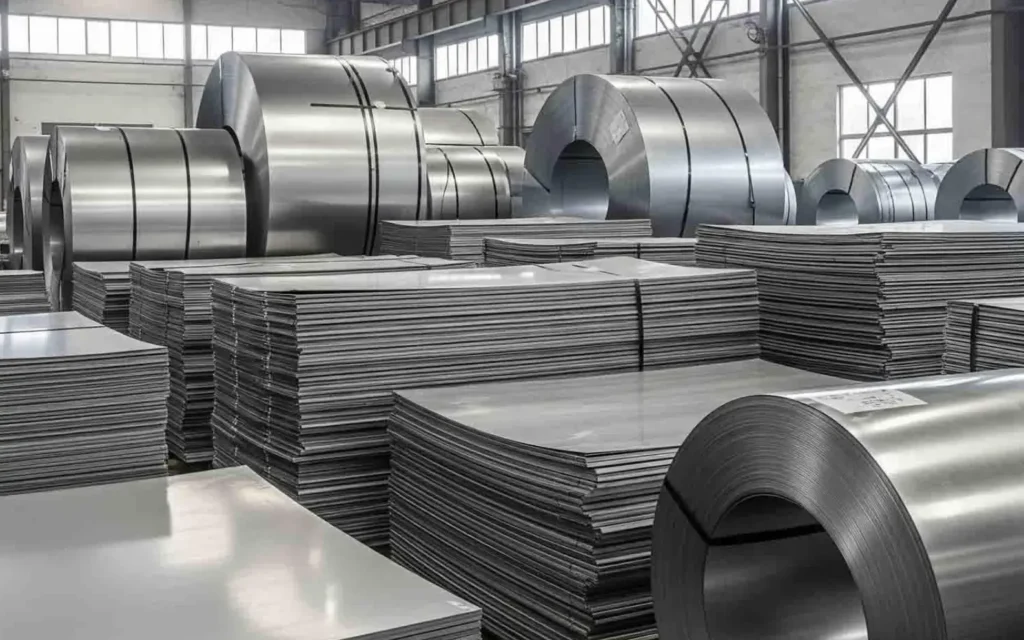
- Inconel Sheets, Plates & Coils Overview
- Inconel Sheets, Plates & Coils Grades
- Types of Inconel Sheets, Plates & Coils
- Inconel Sheets, Plates & Coils Specifications
- Inconel Sheets, Plates & Coils Chemical Composition
- Inconel Sheets, Plates & Coils Mechanical Properties
- Inconel Sheets, Plates & Coils Equivalent Grades
- Inconel Sheets, Plates & Coils Applications
- Why Choose Metals Fabrica for Inconel Sheets, Plates & Coils?
- Inconel Sheets, Plates & Coils FAQs
- Request a Quote for Inconel Sheets, Plates & Coils
Inconel Sheets, Plates & Coils Overview
Inconel sheet, plate and coil are flat-rolled products in nickel-chromium alloys, and the family is normally taken to include the iron-nickel-chromium Incoloy alloys as well. Fabricators use them for shells, liners, baffles, ducts, heat shields and formed parts that must hold their shape and surface in hot, oxidising or corrosive conditions where stainless steel plate would scale, carburise or crack. The trade names are trademarks; orders are placed by alloy number, UNS designation and ASTM product standard.
Each alloy has its own flat-product standard. Alloy 600 and alloy 601 fall under ASTM B168, alloy 625 under B443 in Grade 1 or Grade 2, age-hardenable 718 under B670 and AMS 5596, the 800 series under B409 and alloy 825 under B424. Plate is hot rolled and annealed; sheet and strip are cold rolled to gauge and annealed, and coil is the same cold-rolled product wound for slitting or blanking.
Choosing between them comes down to temperature, atmosphere and stress. Alloy 601 and 800H/800HT suit furnace hardware, 625 and 825 suit wet corrosion, and 718 suits highly stressed parts that are formed first and aged afterwards. Metals Fabrica supplies these alloys as sheet, plate, coil and cut-to-size blanks, with the standard and delivery condition confirmed for each enquiry.
- Standards: ASTM B168, B443, B670, B409, B424; AMS 5596 for 718
- Forms: sheet, plate, coil, strip, shim, circles and cut blanks
- Condition: annealed or solution annealed; 718 solution treated for later ageing
- Related products: Inconel bars and Inconel pipe in the same alloys
Inconel Sheets, Plates & Coils Grades
Inconel 600 Sheets, Plates, Coils
ASTM B168 UNS N06600
Inconel 601 Sheets, Plates, Coils
ASTM B168 UNS N06601
Inconel 625 Sheets, Plates, Coils
ASTM B443 UNS N06625
Inconel 718 Sheets, Plates, Coils
ASTM B670 / AMS 5596 UNS N07718
Incoloy 800 / 800H / 800HT Sheets, Plates, Coils
ASTM B409 UNS N08800 / N08810 / N08811
Incoloy 825 Sheets, Plates, Coils
ASTM B424 UNS N08825
Types of Inconel Sheets, Plates & Coils
Hot-Rolled Annealed Nickel Alloy Plate
Heavier gauges rolled hot, annealed and descaled, used for pressure vessel shells, tube sheets, furnace structures and parts machined or flame cut from thick sections.
Cold-Rolled Inconel Sheet
Thin gauges cold rolled and annealed for a smoother surface and tighter thickness tolerance, suited to pressing, deep drawing, spinning and sheet-metal fabrication.
Inconel Coil and Slit Strip
Cold-rolled product wound in coil and slit to narrow widths for stamping, roll forming, gaskets, bellows, springs and high-volume component production.
Shim Sheet and Thin Foil
Precision thin gauges in 600, 625 and 718 for shims, seals, heat shields and laminations where the part must stay flat and stable in heat.
Circles and Cut-to-Size Blanks
Discs, rings and rectangles cut from plate or sheet by waterjet, plasma or shearing to the buyer's drawing, reducing scrap of costly nickel alloy.
Solution-Annealed High-Temperature Plate
Alloy 625 Grade 2 and alloys 800H and 800HT supplied solution annealed with a coarser grain for creep-rupture strength in furnaces and reformers.
Inconel Sheets, Plates & Coils Specifications
| Specification | Details |
|---|---|
| Product standards | ASTM B168 / ASME SB168 (600, 601), ASTM B443 / ASME SB443 (625), ASTM B670 and AMS 5596 (718), ASTM B409 / ASME SB409 (800, 800H, 800HT), ASTM B424 / ASME SB424 (825) |
| UNS | N06600, N06601, N06625, N07718, N08800, N08810, N08811, N08825 |
| Sheet thickness | 0.3 – 6 mm |
| Plate thickness | 6 – 150 mm and above |
| Width | 1000, 1219, 1500, 2000, 2500 mm and to order |
| Length | 2000, 2500, 3000, 6000 mm; coils and cut to size |
| Finish | Hot rolled annealed and pickled, cold rolled annealed and pickled (2B type), bright annealed (BA); No. 4 and mirror polish on request |
| Forms | Sheet, plate, coil, strip, shim, circles, cut-to-size blanks |
| Edge | Mill edge, slit edge, sheared or cut edge |
| Delivery condition | Annealed or solution annealed as the standard and grade require; 718 solution treated |
| Testing | Tensile and chemical analysis per the product standard; PMI, ultrasonic testing of plate, hardness and corrosion tests on request |
| Documentation | EN 10204 3.1 mill test certificate; EN 10204 3.2 with third-party inspection on request |
General requirements for flat-rolled nickel alloys follow ASTM B906. Thickness, width and finish availability differ by alloy; confirm them in your enquiry.
Inconel Sheets, Plates & Coils Chemical Composition
| Grade | UNS | Ni | Cr | Fe | Mo | C | Other |
|---|---|---|---|---|---|---|---|
| 600 | N06600 | 72.0 min | 14.0 – 17.0 | 6.0 – 10.0 | – | 0.15 | Mn 1.0; Si 0.50; Cu 0.50; S 0.015 |
| 601 | N06601 | 58.0 – 63.0 | 21.0 – 25.0 | Remainder | – | 0.10 | Al 1.0 – 1.7; Mn 1.0; Cu 1.0 |
| 625 | N06625 | 58.0 min | 20.0 – 23.0 | 5.0 | 8.0 – 10.0 | 0.10 | Nb+Ta 3.15 – 4.15; Al 0.40; Ti 0.40 |
| 718 | N07718 | 50.0 – 55.0 | 17.0 – 21.0 | Remainder | 2.80 – 3.30 | 0.08 | Nb+Ta 4.75 – 5.50; Ti 0.65 – 1.15; Al 0.20 – 0.80; B 0.006 |
| 800 | N08800 | 30.0 – 35.0 | 19.0 – 23.0 | 39.5 min | – | 0.10 | Al 0.15 – 0.60; Ti 0.15 – 0.60 |
| 800H | N08810 | 30.0 – 35.0 | 19.0 – 23.0 | 39.5 min | – | 0.05 – 0.10 | Al 0.15 – 0.60; Ti 0.15 – 0.60 |
| 800HT | N08811 | 30.0 – 35.0 | 19.0 – 23.0 | 39.5 min | – | 0.06 – 0.10 | Al 0.15 – 0.60; Ti 0.15 – 0.60; Al+Ti 0.85 – 1.20 |
| 825 | N08825 | 38.0 – 46.0 | 19.5 – 23.5 | 22.0 min | 2.5 – 3.5 | 0.05 | Cu 1.5 – 3.0; Ti 0.6 – 1.2; Al 0.2 |
Nickel for 600 is reported as Ni + Co. Values are summarised for comparison; each grade page gives the full limits.
Inconel Sheets, Plates & Coils Mechanical Properties
| Grade | Standard / Condition | Tensile Strength, min | Yield Strength (0.2% Offset), min | Elongation in 50 mm, min |
|---|---|---|---|---|
| 600 | B168, annealed plate, sheet and strip | 550 MPa (80 ksi) | 240 MPa (35 ksi) | 30% |
| 601 | B168, annealed plate, sheet and strip | 550 MPa (80 ksi) | 205 MPa (30 ksi) | 30% |
| 625 Grade 1 | B443, annealed | 827 MPa (120 ksi) | 414 MPa (60 ksi) | 30% |
| 625 Grade 2 | B443, solution annealed | 690 MPa (100 ksi) | 276 MPa (40 ksi) | 30% |
| 718 | B670, solution treated and precipitation hardened | 1241 MPa (180 ksi) | 1034 MPa (150 ksi) | 12% |
| 800 | B409, annealed | 520 MPa (75 ksi) | 205 MPa (30 ksi) | 30% |
| 800H, 800HT | B409, solution annealed | 450 MPa (65 ksi) | 170 MPa (25 ksi) | 30% |
| 825 | B424, annealed | 586 MPa (85 ksi) | 241 MPa (35 ksi) | 30% |
As-rolled and cold-rolled temper products have different requirements. Confirm against the purchase specification and mill test certificate.
Inconel Sheets, Plates & Coils Equivalent Grades
| Grade | UNS | Werkstoff Nr. | EN | JIS | BS | AFNOR | GOST |
|---|---|---|---|---|---|---|---|
| Alloy 600 | N06600 | 2.4816 | NiCr15Fe | NCF 600 | NA 14 | NC15Fe | – |
| Alloy 601 | N06601 | 2.4851 | NiCr23Fe | NCF 601 | – | NC23FeA | – |
| Alloy 625 | N06625 | 2.4856 | NiCr22Mo9Nb | NCF 625 | NA 21 | NC22DNb | – |
| Alloy 718 | N07718 | 2.4668 | NiCr19Fe19Nb5Mo3 | NCF 718 | – | NC19FeNb | – |
| Alloy 800 | N08800 | 1.4876 | X10NiCrAlTi32-21 | NCF 800 | NA 15 | – | – |
| Alloy 800H / 800HT | N08810 / N08811 | 1.4958 / 1.4959 | X5NiCrAlTi31-20 / X8NiCrAlTi32-21 | NCF 800H | NA 15H | – | – |
| Alloy 825 | N08825 | 2.4858 | NiCr21Mo | NCF 825 | NA 16 | – | – |
Equivalents are approximate and limits differ between standards. Order to the standard named in your specification.
Inconel Sheets, Plates & Coils Applications
Furnace Linings and Heat-Treatment Hardware
Alloy 601 and 800H/800HT sheet and plate for muffles, retorts, baskets, radiant shields and burner parts exposed to repeated heating and oxidising or carburising gas.
Chemical Process Vessels
Alloy 625 and 825 plate for reactor shells, scrubbers, evaporators and tank linings handling acids, chlorides and mixed process streams that pit stainless steel.
Gas Turbine and Aerospace Sheet Parts
Alloy 718 and 625 sheet formed into combustor liners, casings, exhaust ducts and seals, then welded or aged, where strength at temperature and low weight matter.
Flue Gas Desulphurisation and Stacks
Alloy 625 sheet used as wallpaper lining over carbon steel in absorbers, ducts and chimney flues where acidic condensate attacks ordinary steels.
Nuclear and Steam Generator Components
Alloy 600 plate and strip for support plates, baffles and internals where chloride stress-corrosion resistance and stability in high-purity water are required.
Offshore and Marine Equipment
Alloy 625 and 825 plate for splash-zone sheathing, seawater-cooled exchangers and sour-service equipment where chloride pitting and crevice attack must be avoided.
Why Choose Metals Fabrica for Inconel Sheets, Plates & Coils?
- Alloy, standard and form checked together: we confirm that the alloy, UNS number and ASTM or AMS flat-product standard on your enquiry belong together before quoting.
- Thickness and finish reviewed: sheet gauge, plate thickness, width, length, surface finish and edge condition are checked against your drawing.
- Condition stated clearly: annealed, solution annealed, 625 Grade 1 or Grade 2, or 718 solution treated is shown on the quotation and certificate.
- Matching components: plate quoted with Inconel pipe fittings and Inconel flanges for complete fabrication packages.
- Documentation support: EN 10204 3.1 certificates, with PMI and third-party inspection coordinated when your order requires them.
Inconel Sheets, Plates & Coils FAQs
What is the difference between Inconel sheet and Inconel plate?
Sheet is the thinner, cold-rolled product, generally up to about 6 mm, with a smoother surface and closer thickness tolerance. Plate is the heavier, hot-rolled product used for pressure-bearing and structural parts. Both are covered by the same ASTM standard for each alloy.
Which ASTM standard applies to each Inconel plate grade?
Alloys 600 and 601 are ordered to ASTM B168, alloy 625 to B443, alloy 718 to B670 or AMS 5596, the 800 series to B409, and alloy 825 to B424. Naming the alloy without the standard can lead to the wrong condition being supplied.
Which Inconel sheet grade is best for furnace parts?
Alloy 601 is widely chosen for its aluminium-assisted oxide scale and resistance to spalling during thermal cycling. Alloys 800H and 800HT are preferred where the part also carries load at high temperature, because their controlled carbon and coarse grain improve creep strength.
Can Inconel plate be cut to size?
Yes. Nickel alloy plate and sheet are commonly supplied as cut-to-size rectangles, circles and blanks by waterjet, plasma or shearing. State the cutting method if heat-affected edges are not acceptable.
What should an Inconel sheet or plate enquiry include?
Give the alloy and UNS number, product standard, thickness, width, length or coil, finish, edge, delivery condition, quantity, tests and certificates required, and the delivery location.