- Mohammed Ali Road, Mumbai, Maharashtra 400003, India.


Inconel 601 Sheets, Plates, Coils Supplier in Mumbai, India
- Home
- Products
- Sheets, Plates & Coils
- Inconel Sheets, Plates & Coils Supplier in Mumbai, India
- Inconel 601 Sheets, Plates, Coils Supplier in Mumbai, India
- Inconel 601 Sheets, Plates, Coils Overview
- Types of Inconel 601 Sheets, Plates, Coils
- Inconel 601 Sheets, Plates, Coils Specifications
- Inconel 601 Sheets, Plates, Coils Chemical Composition
- Inconel 601 Sheets, Plates, Coils Mechanical Properties
- Inconel 601 Sheets, Plates, Coils Equivalent Grades
- Inconel 601 Sheets, Plates, Coils Applications
- Why Choose Metals Fabrica for Inconel 601 Sheets, Plates, Coils?
- Inconel 601 Sheets, Plates, Coils FAQs
- Request a Quote for Inconel 601 Sheets, Plates, Coils
Inconel 601 Sheets, Plates, Coils Overview
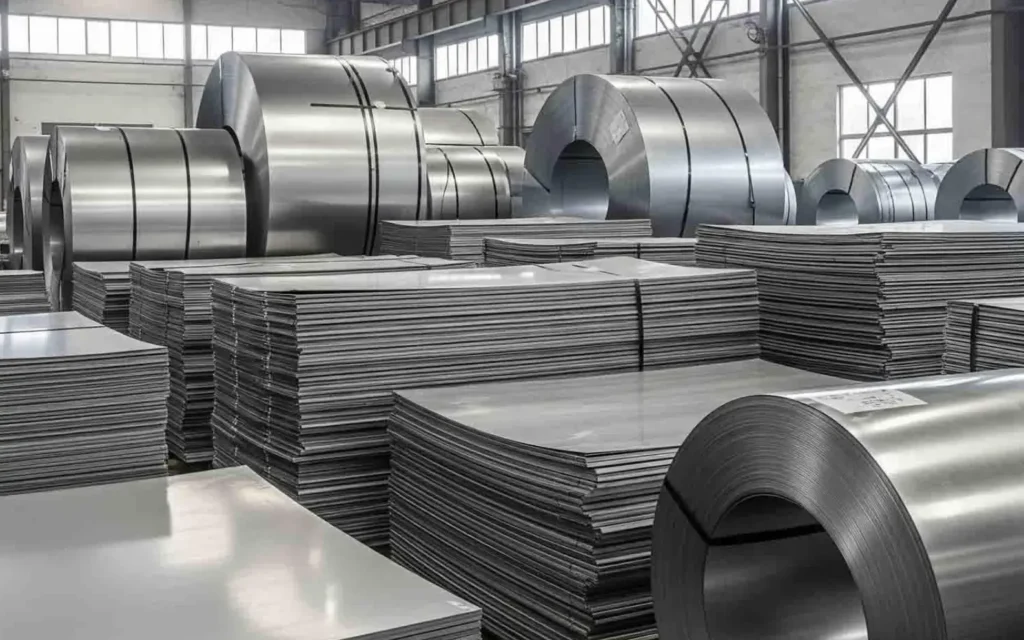
Inconel 601 is a nickel-chromium-iron alloy with 58–63% nickel, 21–25% chromium and 1.0–1.7% aluminium. The extra chromium and the aluminium together form a tightly adherent oxide scale that resists spalling when a part is heated and cooled repeatedly, which is why 601 sheet and plate are standard materials for furnace hardware operating up to about 1200 °C.
ASTM B168 covers 601 in the same flat-product standard as alloy 600. Plate is hot rolled and annealed, while sheet and coil are cold rolled and annealed for forming. The alloy is ductile in the annealed condition and can be bent, rolled into cylinders, pressed and welded, which suits the fabricated baskets, trays and radiant tubes made from it. It also resists carburisation and attack by sulphur-bearing gases better than higher-nickel alloy 600.
Choose 601 over Inconel 600 sheet when cyclic oxidation is the main concern rather than caustic or chloride corrosion. Where the part also carries a sustained load at temperature, Incoloy 800H/800HT plate offers better creep strength. Metals Fabrica supplies 601 sheet, plate and coil, with thickness and condition confirmed against the furnace drawing.
- Standard: ASTM B168 / ASME SB168, UNS N06601
- Alloying: high chromium plus aluminium for a protective, adherent scale
- Service: oxidising and carburising atmospheres to about 1200 °C
- Condition: annealed plate, sheet and strip
Types of Inconel 601 Sheets, Plates, Coils
Inconel 601 Plate for Furnace Structures
Hot-rolled annealed plate used for hearth plates, retort flanges, burner mounting plates and furnace frames that must hold shape through long periods at temperature.
Inconel 601 Cold-Rolled Sheet
Annealed sheet with a pickled surface for muffles, radiant shields, ducts and fabricated baskets that are rolled, bent and welded in the workshop.
Inconel 601 Coil and Strip
Cold-rolled coil slit to width for mesh belt components, thermocouple protection, strip heaters and continuously formed sections in heat-treatment lines.
Inconel 601 Cut Blanks and Discs
Plate and sheet cut to drawing for trays, fixtures, end caps and burner nozzles, which saves machining time and reduces offcuts in an expensive alloy.
Inconel 601 Sheets, Plates, Coils Specifications
| Specification | Details |
|---|---|
| Product standard | ASTM B168 / ASME SB168 |
| UNS / Werkstoff Nr. | N06601 / 2.4851 |
| Sheet thickness | 0.3 – 6 mm |
| Plate thickness | 6 – 150 mm and above |
| Width | 1000, 1219, 1500, 2000, 2500 mm and to order |
| Length | 2000, 2500, 3000, 6000 mm; coils and cut to size |
| Finish | Hot rolled annealed and pickled, cold rolled annealed and pickled, bright annealed on request |
| Forms | Sheet, plate, coil, strip, circles, cut-to-size blanks |
| Delivery condition | Annealed |
| Testing | Tensile and chemical analysis per B168; PMI and ultrasonic testing of plate on request |
| Documentation | EN 10204 3.1 mill test certificate; EN 10204 3.2 on request |
Specify whether the part will be formed or welded so the correct finish and condition can be confirmed.
Inconel 601 Sheets, Plates, Coils Chemical Composition
| Grade | UNS | Ni | Cr | Fe | Al | C | Mn | Si | S | Cu |
|---|---|---|---|---|---|---|---|---|---|---|
| 601 | N06601 | 58.0 – 63.0 | 21.0 – 25.0 | Remainder | 1.0 – 1.7 | 0.10 | 1.0 | 0.50 | 0.015 | 1.0 |
Inconel 601 Sheets, Plates, Coils Mechanical Properties
| Product / Condition | Density | Melting Range | Tensile Strength, min | Yield Strength (0.2% Offset), min | Elongation in 50 mm, min |
|---|---|---|---|---|---|
| Hot-rolled plate, annealed | 8.11 g/cm³ | 1360 – 1411 °C | 550 MPa (80 ksi) | 205 MPa (30 ksi) | 30% |
| Cold-rolled sheet and strip, annealed | 8.11 g/cm³ | 1360 – 1411 °C | 550 MPa (80 ksi) | 205 MPa (30 ksi) | 30% |
Density and melting range are typical values, not B168 requirements. Elevated-temperature design data come from the ASME Code, not the room-temperature minimums.
Inconel 601 Sheets, Plates, Coils Equivalent Grades
| Grade | UNS | Werkstoff Nr. | EN | JIS | BS | AFNOR | GOST |
|---|---|---|---|---|---|---|---|
| Inconel 601 | N06601 | 2.4851 | NiCr23Fe | NCF 601 | – | NC23FeA | – |
Equivalents are approximate. Order to the standard named in your specification.
Inconel 601 Sheets, Plates, Coils Applications
Heat-Treatment Baskets and Trays
Fabricated baskets, trays and fixtures that pass through carburising, hardening and annealing furnaces many times, where 601 scale resists flaking during each cycle.
Radiant Tubes and Muffles
Rolled and welded sheet for radiant tubes, muffles and retorts in gas-fired and electric furnaces operating in oxidising or carburising atmospheres.
Burners and Combustion Equipment
Flame shields, burner cans and combustion liners exposed to direct heat and hot combustion products containing some sulphur.
Thermal Reactors and Incinerators
Liners and internals for exhaust thermal reactors, waste incinerators and flare tips, where high-temperature oxidation is the main failure mode.
Nitric Acid Catalyst Supports
Grids and support structures in ammonia oxidation units, where 601 withstands hot oxidising gases around the catalyst gauzes.
Why Choose Metals Fabrica for Inconel 601 Sheets, Plates, Coils?
- Furnace duty reviewed: we check your operating temperature and atmosphere to confirm 601 rather than 600 or 800H is the right choice.
- Sizes matched to fabrication: sheet gauge, plate thickness and cut sizes are reviewed against your basket, muffle or retort drawing.
- Other forms in 601: sheet can be quoted with Inconel 601 bar for fixture rods and 601 pipe for radiant tubes.
- Certification: EN 10204 3.1 certificates with heat number traceability, and third-party inspection coordinated when required.
Inconel 601 Sheets, Plates, Coils FAQs
What is the difference between Inconel 600 and 601 sheet?
Alloy 601 has more chromium (21–25% against 14–17%) and adds 1.0–1.7% aluminium, so it forms a more protective, adherent oxide at high temperature. Alloy 600 has more nickel and is better for caustic and chloride stress-corrosion service.
What temperature can Inconel 601 plate withstand?
Alloy 601 is widely used for oxidation resistance up to about 1200 °C. Load-bearing parts are designed with lower temperatures and stresses, using ASME Code allowable stresses where the equipment is code-stamped.
Can Inconel 601 sheet be welded?
Yes. Annealed 601 sheet and plate are welded by GTAW, GMAW and SMAW using nickel-chromium filler metals of matching or higher oxidation resistance. Joints should be clean and free of sulphur-bearing contaminants before welding.
Which standard should I quote for Inconel 601 plate?
Specify ASTM B168 or ASME SB168 with UNS N06601. Because B168 covers several alloys, stating the UNS number avoids confusion with alloy 600.