- Mohammed Ali Road, Mumbai, Maharashtra 400003, India.



ASTM A516 Grade 60 Sheet, Plate & Coil Supplier in Mumbai
- Home
- Products
- Sheets, Plates & Coils
- Carbon Steel Sheets, Plates & Coils Supplier in Mumbai, India
- ASTM A516 Grade 60 Sheet, Plate & Coil Supplier in Mumbai
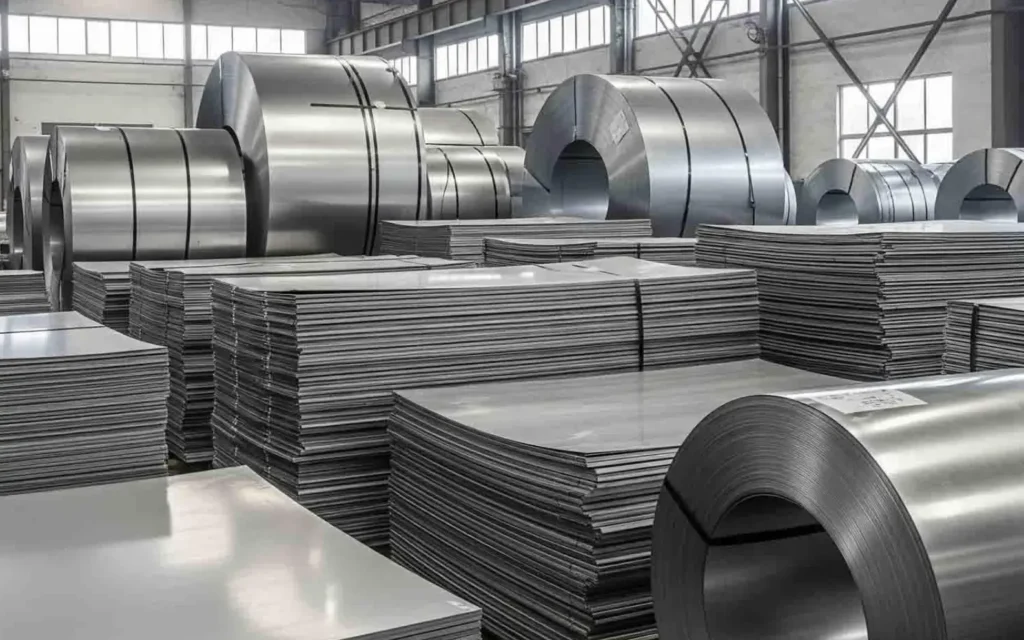
- ASTM A516 Grade 60 Sheet, Plate & Coil Overview
- Types of ASTM A516 Grade 60 Sheet, Plate & Coil
- ASTM A516 Grade 60 Sheet, Plate & Coil Specifications
- ASTM A516 Grade 60 Sheet, Plate & Coil Chemical Composition
- ASTM A516 Grade 60 Sheet, Plate & Coil Mechanical Properties
- ASTM A516 Grade 60 Sheet, Plate & Coil Equivalent Grades
- ASTM A516 Grade 60 Sheet, Plate & Coil Applications
- Why Choose Metals Fabrica for ASTM A516 Grade 60 Sheet, Plate & Coil?
- ASTM A516 Grade 60 Sheet, Plate & Coil FAQs
- Request a Quote for ASTM A516 Grade 60 Sheet, Plate & Coil
ASTM A516 Grade 60 Sheet, Plate & Coil Overview
ASTM A516 covers carbon steel pressure vessel plates for moderate- and lower-temperature service, and Grade 60 is its lower-strength grade alongside Grade 55. It requires 415–550 MPa tensile strength and 220 MPa (32 ksi) minimum yield. Because its carbon content is the lowest of Grades 60, 65 and 70, it has the best formability and weldability of the three and is a common choice where low-temperature impact toughness is the main requirement.
A516 is killed steel made to fine austenitic grain size practice, which is the key difference from A515 Grade 60. Grade 60 allows 0.21% carbon up to 12.5 mm, rising to 0.27% above 100 mm. Manganese is unusual: 0.60–0.90% in plate up to 12.5 mm and 0.85–1.20% in thicker plate. Plate over 40 mm must be normalised; thinner plate is normally as-rolled, but is normalised when Charpy tests are specified unless the purchaser agrees otherwise.
Grade 60 suits low-temperature vessels, refrigerant receivers and vessels that will be heavily cold formed. Where a higher design stress is needed, A516 Grade 70 gives 485 MPa minimum tensile. Metals Fabrica supplies A516 Grade 60 plate and confirms normalising, impact temperature and any HIC requirement against your data sheet.
- Standard: ASTM A516 / A516M, ASME SA516 Grade 60; ASTM A20
- Steelmaking: killed, fine-grain practice
- Heat treatment: normalising mandatory over 40 mm
- Welded pipe: plate grade for ASTM A671 CC60 and A672 C60 pipe
Types of ASTM A516 Grade 60 Sheet, Plate & Coil
Normalised A516 Grade 60 Plate
Normalised plate with refined grain, required above 40 mm and specified for thinner plate when Charpy testing is part of the order.
A516 Grade 60 with Charpy Testing
Plate impact tested under ASTM A20 supplementary requirement S5 at the purchaser's design temperature, for low-temperature vessels and refrigerated equipment.
A516 Grade 60 HIC-Tested Plate
Low-sulphur plate tested for hydrogen-induced cracking to NACE TM0284 for wet sour service, ordered to a purchaser specification.
As-Rolled A516 Grade 60 Plate
Thin plate up to 40 mm supplied as-rolled where neither the code nor the purchaser requires normalising or impact tests.
A516 Grade 60 Hot Rolled Coil
Thin-gauge A516 Grade 60 coil, cut to length as sheet for small vessels, heads and formed components where pressure-vessel quality is required.
ASTM A516 Grade 60 Sheet, Plate & Coil Specifications
| Specification | Details |
|---|---|
| Standard | ASTM A516 / A516M Grade 60; ASME SA516 Grade 60 |
| UNS | K02100 |
| General requirements | ASTM A20 / A20M |
| Thickness | Sheet 0.3 – 6 mm; plate 6 – 150 mm and above |
| Width | 1000, 1219, 1500, 2000, 2500 mm and to order |
| Length | 2000, 2500, 3000, 6000 mm; coils and cut to size |
| Steelmaking | Killed, fine austenitic grain size practice |
| Delivery condition | As-rolled up to 40 mm; normalised over 40 mm; normalised for impact-tested plate |
| Surface finish | Hot rolled black, shot blasted and primed |
| Testing | Tension test per A20; Charpy V-notch (S5), ultrasonic (A435 / A578), simulated PWHT, HIC to NACE TM0284 on request |
| Documentation | EN 10204 3.1 mill test certificate; EN 10204 3.2 with third-party inspection on request |
Give the minimum design metal temperature so the impact test temperature and normalising can be confirmed.
ASTM A516 Grade 60 Sheet, Plate & Coil Chemical Composition
| Plate thickness | C | Mn | P | S | Si |
|---|---|---|---|---|---|
| ≤ 12.5 mm | 0.21 | 0.60 – 0.90 | 0.025 | 0.025 | 0.15 – 0.40 |
| > 12.5 to 50 mm | 0.23 | 0.85 – 1.20 | 0.025 | 0.025 | 0.15 – 0.40 |
| > 50 to 100 mm | 0.25 | 0.85 – 1.20 | 0.025 | 0.025 | 0.15 – 0.40 |
| > 100 mm | 0.27 | 0.85 – 1.20 | 0.025 | 0.025 | 0.15 – 0.40 |
Residual Cu, Ni, Cr, Mo, V and Nb are limited by ASTM A20. Lower sulphur and a carbon-equivalent maximum can be agreed for HIC-resistant or weld-critical service.
ASTM A516 Grade 60 Sheet, Plate & Coil Mechanical Properties
| Grade | Tensile Strength | Yield Strength, min | Elongation in 200 mm, min | Elongation in 50 mm, min |
|---|---|---|---|---|
| Grade 60 | 415 – 550 MPa (60 – 80 ksi) | 220 MPa (32 ksi) | 21% | 25% |
Impact energy, when specified, is agreed under ASTM A20. Density about 7.85 g/cm³ (typical, not a requirement).
ASTM A516 Grade 60 Sheet, Plate & Coil Equivalent Grades
| Grade | UNS | EN | JIS | GB | IS |
|---|---|---|---|---|---|
| ASTM A516 Grade 60 | K02100 | P265GH (EN 10028-2) | SGV410 (JIS G3118) | Q245R | – |
Equivalents are approximate; impact requirements and thickness bands differ. Use them only with the vessel designer's approval.
ASTM A516 Grade 60 Sheet, Plate & Coil Applications
Low-Temperature Vessels
Normalised, impact-tested plate for vessels whose minimum design metal temperature is below ambient, such as gas processing and refrigeration units.
Ammonia and Refrigerant Receivers
Receivers and accumulators in cold-storage and refrigeration plants, where toughness at low temperature matters more than maximum strength or minimum wall.
Heavily Formed Heads and Cones
Lower carbon makes Grade 60 easier to cold form into dished ends, cones and transitions with less risk of cracking.
Sour Service Separators
HIC-tested plate for separators, knock-out drums and scrubbers handling wet H2S in oil and gas production and gas processing.
Welded Pipe from Plate
Plate for ASTM A671 CC60 and A672 C60 electric-fusion-welded pipe in large-diameter process and low-temperature lines that need the toughness of fine-grain plate.
Why Choose Metals Fabrica for ASTM A516 Grade 60 Sheet, Plate & Coil?
- Impact requirements carried through: Charpy temperature, energy and normalising are confirmed against your design metal temperature.
- Grade choice reviewed: we check whether Grade 60, 65 or 70 best balances strength and toughness for your vessel.
- Sour service checks: HIC testing, sulphur limits and hardness are listed when your specification requires them.
- Low-temperature nozzles: plate quoted with A350 LF2 flanges and A420 WPL6 fittings.
- Documentation: EN 10204 3.1 certificates; 3.2 third-party inspection arranged when required.
ASTM A516 Grade 60 Sheet, Plate & Coil FAQs
Why is A516 Grade 60 chosen over Grade 70?
Grade 60 has lower carbon, so it is easier to form and weld and generally reaches impact requirements more readily. It is chosen for low-temperature or heavily formed vessels where its lower 220 MPa yield is acceptable.
Why does A516 Grade 60 manganese change at 12.5 mm?
Thin plate up to 12.5 mm has a 0.60–0.90% manganese range, while thicker plate requires 0.85–1.20%. The higher manganese helps thicker plate reach strength without raising carbon.
Does A516 Grade 60 have to be normalised?
Plate over 40 mm must be normalised. Thinner plate can be as-rolled, but when Charpy tests are specified the standard requires normalising unless the purchaser agrees otherwise.
What is the lowest temperature for A516 Grade 60?
There is no single limit. The minimum design metal temperature depends on thickness, heat treatment and impact testing under the design code, such as ASME Section VIII UCS-66.
What pipe is made from A516 Grade 60 plate?
ASTM A671 Grade CC60 and ASTM A672 Grade C60 electric-fusion-welded pipe are made from A516 Grade 60 plate.
Request a Quote for ASTM A516 Grade 60 Sheet, Plate & Coil
Sheets, Plates & Coils by material
Carbon Steel Sheet, Plate, Coil grades
- Carbon Steel Sheet, Plate, Coil
- ASTM A36 Sheet Plate, Coil
- ASTM A283 Grade C Sheet Plate, Coil
- ASTM A285 Grade C Sheet Plate, Coil
- ASTM A515 Gr 60 Sheet Plate, Coil
- ASTM A515 Gr 70 Sheet Plate, Coil
- ASTM A572 Grade 50 Sheet Plate, Coil
- ASTM A516 Grade 60 Sheet Plate, Coil
- ASTM A516 Grade 65 Sheet Plate, Coil
- ASTM A516 Grade 70 Sheet Plate, Coil
- ASTM A537 Class 2 Sheet Plate, Coil
- ASTM A709 Grade 36 Sheet Plate, Coil
- C45 Sheet Plate, Coil
- IS 2062 E250 / E350 Sheet Plate, Coil