- Mohammed Ali Road, Mumbai, Maharashtra 400003, India.



ASTM A516 Grade 70 Sheet, Plate & Coil Supplier in Mumbai
- Home
- Products
- Sheets, Plates & Coils
- Carbon Steel Sheets, Plates & Coils Supplier in Mumbai, India
- ASTM A516 Grade 70 Sheet, Plate & Coil Supplier in Mumbai
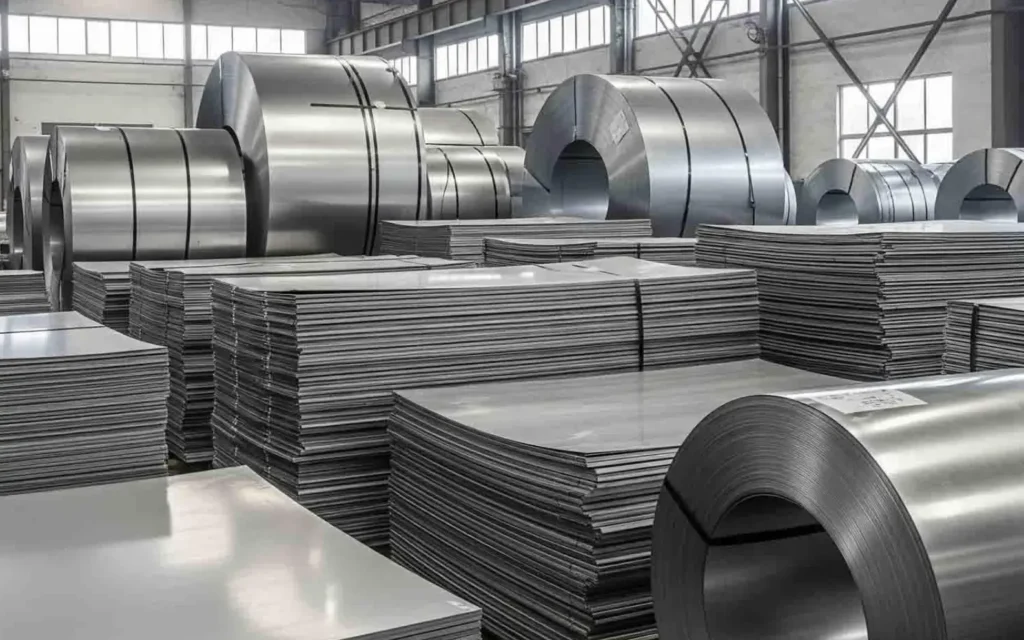
- ASTM A516 Grade 70 Sheet, Plate & Coil Overview
- Types of ASTM A516 Grade 70 Sheet, Plate & Coil
- ASTM A516 Grade 70 Sheet, Plate & Coil Specifications
- ASTM A516 Grade 70 Sheet, Plate & Coil Chemical Composition
- ASTM A516 Grade 70 Sheet, Plate & Coil Mechanical Properties
- ASTM A516 Grade 70 Sheet, Plate & Coil Equivalent Grades
- ASTM A516 Grade 70 Sheet, Plate & Coil Applications
- Why Choose Metals Fabrica for ASTM A516 Grade 70 Sheet, Plate & Coil?
- ASTM A516 Grade 70 Sheet, Plate & Coil FAQs
- Request a Quote for ASTM A516 Grade 70 Sheet, Plate & Coil
ASTM A516 Grade 70 Sheet, Plate & Coil Overview
A516 Grade 70 is the most widely specified carbon steel pressure vessel plate. As the highest-strength grade of ASTM A516, it requires 485–620 MPa (70–90 ksi) tensile strength and 260 MPa (38 ksi) minimum yield, which gives the highest allowable stress in the family and therefore the thinnest vessel walls. ASME lists it as SA516 Grade 70 under Section VIII.
The plate is killed, fine-grain steel with carbon from 0.27% maximum up to 12.5 mm to 0.31% above 100 mm, manganese 0.85–1.20% and silicon 0.15–0.40%. Fine grain gives better notch toughness than coarse-grained A515 Grade 70 at the same strength. Plate over 40 mm must be normalised, and thinner plate is normalised when Charpy tests are ordered. For sour service, Grade 70 is commonly bought with reduced sulphur, a carbon-equivalent cap and hydrogen-induced cracking tests to NACE TM0284.
Choose Grade 70 for general pressure vessels, columns, heat exchangers and storage spheres where strength and toughness are both required. Where higher strength is needed again, quenched and tempered A537 Class 2 is the next step. Metals Fabrica supplies A516 Grade 70 plate and confirms heat treatment, impact temperature, HIC and PWHT requirements against your data sheet.
- Standard: ASTM A516 / A516M, ASME SA516 Grade 70; ASTM A20
- Strength: 485–620 MPa tensile, 260 MPa yield minimum
- Heat treatment: normalised over 40 mm or when impact tested
- Welded pipe: plate grade for ASTM A671 CC70 and A672 C70 pipe
Types of ASTM A516 Grade 70 Sheet, Plate & Coil
A516 Grade 70N (Normalised)
Normalised plate, often marked 70N, with refined grain for consistent impact properties; required above 40 mm and standard for most vessel work.
A516 Grade 70 HIC-Tested Plate
Low-sulphur, calcium-treated plate tested to NACE TM0284 for hydrogen-induced cracking resistance in wet H2S service, ordered to purchaser limits.
A516 Grade 70 Low-Temperature Plate
Normalised plate Charpy tested at sub-zero temperatures under ASTM A20 S5 for vessels with low minimum design metal temperatures.
A516 Grade 70 with Simulated PWHT
Test coupons given simulated post-weld heat treatment so certified tensile and impact values hold after vessel stress relief.
A516 Grade 70 Z-Direction Plate
Plate tested for through-thickness ductility to ASTM A770 for nozzle and attachment welds loaded across the plate thickness.
A516 Grade 70 Hot Rolled Coil
Grade 70 coil in thinner gauges, decoiled into cut-to-length sheet for small vessels, gas cylinders, formed heads and other light pressure parts.
ASTM A516 Grade 70 Sheet, Plate & Coil Specifications
| Specification | Details |
|---|---|
| Standard | ASTM A516 / A516M Grade 70; ASME SA516 Grade 70 |
| UNS | K02700 |
| General requirements | ASTM A20 / A20M |
| Thickness | Sheet 0.3 – 6 mm; plate 6 – 150 mm and above |
| Width | 1000, 1219, 1500, 2000, 2500 mm and to order |
| Length | 2000, 2500, 3000, 6000 mm; coils and cut to size |
| Steelmaking | Killed, fine austenitic grain size practice |
| Delivery condition | As-rolled up to 40 mm; normalised over 40 mm and for impact-tested plate; normalised and stress relieved on request |
| Surface finish | Hot rolled black, shot blasted and primed |
| Testing | Tension test per A20; Charpy V-notch (S5), ultrasonic (A435 / A578), Z-direction (A770), simulated PWHT, HIC (NACE TM0284) on request |
| Documentation | EN 10204 3.1 mill test certificate; EN 10204 3.2 with third-party inspection on request |
For sour service, attach the purchaser's material specification so sulphur, CE, hardness and HIC acceptance limits can be quoted.
ASTM A516 Grade 70 Sheet, Plate & Coil Chemical Composition
| Plate thickness | C | Mn | P | S | Si |
|---|---|---|---|---|---|
| ≤ 12.5 mm | 0.27 | 0.85 – 1.20 | 0.025 | 0.025 | 0.15 – 0.40 |
| > 12.5 to 50 mm | 0.28 | 0.85 – 1.20 | 0.025 | 0.025 | 0.15 – 0.40 |
| > 50 to 100 mm | 0.30 | 0.85 – 1.20 | 0.025 | 0.025 | 0.15 – 0.40 |
| > 100 mm | 0.31 | 0.85 – 1.20 | 0.025 | 0.025 | 0.15 – 0.40 |
Residual elements are limited by ASTM A20. HIC-resistant plate is usually ordered with much lower sulphur and a CE maximum set by the purchaser.
ASTM A516 Grade 70 Sheet, Plate & Coil Mechanical Properties
| Grade | Tensile Strength | Yield Strength, min | Elongation in 200 mm, min | Elongation in 50 mm, min |
|---|---|---|---|---|
| Grade 70 | 485 – 620 MPa (70 – 90 ksi) | 260 MPa (38 ksi) | 17% | 21% |
Charpy energy and test temperature are set by the order under ASTM A20. Density about 7.85 g/cm³ (typical, not a requirement).
ASTM A516 Grade 70 Sheet, Plate & Coil Equivalent Grades
| Grade | UNS | EN | JIS | GB | IS |
|---|---|---|---|---|---|
| ASTM A516 Grade 70 | K02700 | P355GH (EN 10028-2) | SGV480 (JIS G3118) | Q345R | – |
Equivalents are approximate; P355GH has a higher yield requirement in thin plate and different impact rules. Use only with the designer's approval.
ASTM A516 Grade 70 Sheet, Plate & Coil Applications
Refinery and Petrochemical Vessels
Columns, drums, reactors and accumulators where Grade 70's allowable stress keeps shell thickness and weight down, reducing welding time and transport weight.
Sour Gas Equipment
HIC-tested plate for separators, scrubbers and amine units handling wet hydrogen sulphide, to NACE MR0175 / ISO 15156 based purchaser specifications.
Boilers and Steam Drums
Drums and pressure parts of package and industrial boilers operating at moderate temperatures, where good toughness during cold start-up is valued.
LPG Bullets and Storage Spheres
Normalised, impact-tested plate for horizontal bullets, mounded vessels and smaller spheres storing propane, butane and other liquefied gases under pressure.
Heat Exchangers
Shells, channels, covers and tube sheets in shell-and-tube exchangers in refining, power and chemical plants, the usual carbon steel plate for exchanger pressure parts.
Large-Diameter Welded Pipe
Plate for ASTM A671 CC70 and A672 C70 electric-fusion-welded pipe in cooling-water, flare and process headers beyond seamless pipe sizes.
Why Choose Metals Fabrica for ASTM A516 Grade 70 Sheet, Plate & Coil?
- Data sheet review: normalising, impact temperature, simulated PWHT cycle and ultrasonic level are confirmed before we quote.
- Sour service requirements: sulphur, CE, hardness and HIC acceptance from your specification carried into the order.
- Thickness band checked: certified carbon is compared against the A516 limit for the plate thickness.
- Vessel package: plate quoted with A671 CC70 pipe, A350 LF2 flanges and carbon steel fittings.
- Documentation: EN 10204 3.1 as standard; 3.2 inspection coordinated when required.
ASTM A516 Grade 70 Sheet, Plate & Coil FAQs
What does A516 Grade 70N mean?
The N indicates the plate has been normalised. Normalising is mandatory for A516 plate over 40 mm and is commonly specified for thinner plate to improve and stabilise impact toughness.
What is the difference between A516 Grade 70 and A515 Grade 70?
They share the same 485–620 MPa tensile and 260 MPa yield requirements. A516 is fine-grain steel for moderate- and lower-temperature service with better toughness; A515 is coarse-grain steel for intermediate- and higher-temperature service.
What is HIC-tested A516 Grade 70?
It is plate made with very low sulphur and inclusion control, then tested to NACE TM0284 for hydrogen-induced cracking. The acceptance limits for crack ratios are set by the purchaser’s specification, not by ASTM A516.
Is SA516 Grade 70 the same as ASTM A516 Grade 70?
ASME SA516 adopts ASTM A516 with any additional ASME requirements. Plate dual-certified to both is normally supplied for ASME code vessels.
What is the carbon content of A516 Grade 70?
Carbon is limited by thickness: 0.27% up to 12.5 mm, 0.28% to 50 mm, 0.30% to 100 mm and 0.31% above 100 mm.
Request a Quote for ASTM A516 Grade 70 Sheet, Plate & Coil
Sheets, Plates & Coils by material
Carbon Steel Sheet, Plate, Coil grades
- Carbon Steel Sheet, Plate, Coil
- ASTM A36 Sheet Plate, Coil
- ASTM A283 Grade C Sheet Plate, Coil
- ASTM A285 Grade C Sheet Plate, Coil
- ASTM A515 Gr 60 Sheet Plate, Coil
- ASTM A515 Gr 70 Sheet Plate, Coil
- ASTM A572 Grade 50 Sheet Plate, Coil
- ASTM A516 Grade 60 Sheet Plate, Coil
- ASTM A516 Grade 65 Sheet Plate, Coil
- ASTM A516 Grade 70 Sheet Plate, Coil
- ASTM A537 Class 2 Sheet Plate, Coil
- ASTM A709 Grade 36 Sheet Plate, Coil
- C45 Sheet Plate, Coil
- IS 2062 E250 / E350 Sheet Plate, Coil