- Mohammed Ali Road, Mumbai, Maharashtra 400003, India.



SS 316Ti Sheets, Plates, Coils Supplier in Mumbai, India
- Home
- Products
- Sheets, Plates & Coils
- Stainless Steel Sheets, Plates & Coils Supplier in Mumbai
- SS 316Ti Sheets, Plates, Coils Supplier in Mumbai, India
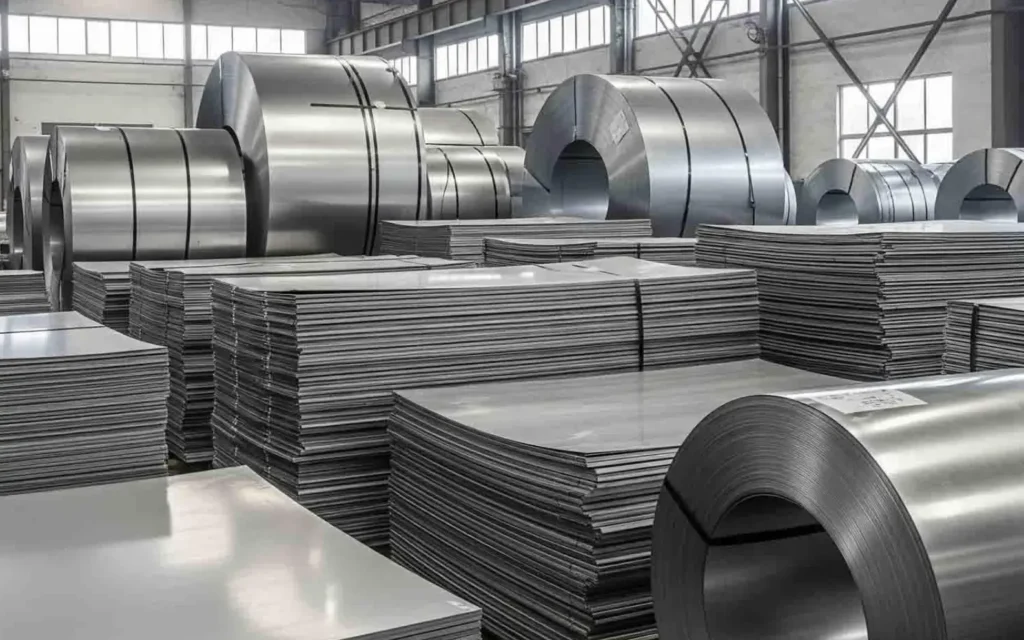
- SS 316Ti Sheets, Plates, Coils Overview
- Types of SS 316Ti Sheets, Plates, Coils
- SS 316Ti Sheets, Plates, Coils Specifications
- SS 316Ti Sheets, Plates, Coils Chemical Composition
- SS 316Ti Sheets, Plates, Coils Mechanical Properties
- SS 316Ti Sheets, Plates, Coils Equivalent Grades
- SS 316Ti Sheets, Plates, Coils Applications
- Why Choose Metals Fabrica for SS 316Ti Sheets, Plates, Coils?
- SS 316Ti Sheets, Plates, Coils FAQs
- Request a Quote for SS 316Ti Sheets, Plates, Coils
SS 316Ti Sheets, Plates, Coils Overview
316Ti is a 316 molybdenum austenitic stainless steel stabilised with titanium. The titanium, at least five times the combined carbon and nitrogen content and no more than 0.70%, combines with carbon to form stable titanium carbides. This keeps chromium in solution when the plate is welded or held in the sensitising range of roughly 425–815 °C, so the steel resists intergranular corrosion even after long exposure to heat.
Its molybdenum, chromium and nickel ranges match 316, so pitting resistance in chlorides is similar. The difference lies in behaviour at temperature: where 316L relies on low carbon and can sensitise slowly in prolonged hot service, 316Ti stays stable. That is why 316Ti, as Werkstoff 1.4571, is widely written into German and European specifications for heat exchangers, flue-gas equipment and chemical vessels. Titanium carbonitride particles make it less suited to mirror polishing than 316L.
A240 lists 316Ti as UNS S31635 with the same tensile minimums as 316 (515 MPa, 205 MPa yield, 40% elongation). For hotter service where creep governs, 316H plate is the alternative. Metals Fabrica supplies 316Ti sheet, plate and coil and can quote SS 316Ti pipe and SS 316Ti flanges for complete equipment packages.
- Standard: ASTM A240 / ASME SA240 Type 316Ti, UNS S31635
- Stabiliser: titanium 5×(C+N) minimum, 0.70% maximum
- European equivalent: 1.4571, X6CrNiMoTi17-12-2
- Hardness: 217 HBW / 95 HRB maximum
Types of SS 316Ti Sheets, Plates, Coils
SS 316Ti Hot Rolled Plate
Solution-annealed and pickled No. 1 plate for vessel shells, tube sheets and flanges cut from plate in equipment that operates in the sensitising range.
SS 316Ti Cold Rolled Sheet
2B finish sheet for heat-exchanger plates, flue-gas ducting and formed parts where welded seams must stay resistant to intergranular corrosion.
SS 316Ti Coils and Strip
Coil and slit strip for welded tube production, expansion bellows and pressed components that require a stabilised molybdenum grade.
1.4571 Plate to EN 10028-7
Plate certified as 1.4571 for European pressure-equipment designs, or dual marked with A240 316Ti where both standards are named in the specification.
SS 316Ti Cut-to-Size Blanks
Plate and sheet cut to drawing dimensions, circles or strips for baffles, nozzles and reinforcement pads, reducing waste and fabrication time.
SS 316Ti Sheets, Plates, Coils Specifications
| Specification | Details |
|---|---|
| Standard | ASTM A240 / ASME SA240 Type 316Ti; general requirements ASTM A480; EN 10028-7 / EN 10088-2 1.4571 on request |
| UNS | S31635 |
| Thickness | Sheet 0.3 – 6 mm; plate 6 – 150 mm and above |
| Width | 1000, 1219, 1500, 2000, 2500 mm and to order |
| Length | 2000, 2500, 3000, 6000 mm; coils; cut to size |
| Finish | No. 1, 2D, 2B, BA, No. 4 |
| Forms | Sheet, plate, coil, strip, circles and cut-to-size blanks |
| Edge | Mill edge or slit edge |
| Heat treatment | Solution annealed, rapidly cooled and pickled |
| Hardness | 217 HBW / 95 HRB maximum |
| Testing | Tensile, hardness; IGC to ASTM A262, PMI including Ti check, plate UT on request |
| Documentation | EN 10204 3.1 mill test certificate; EN 10204 3.2 on request |
Confirm whether your specification calls for A240 316Ti, EN 1.4571 or both.
SS 316Ti Sheets, Plates, Coils Chemical Composition
| Grade | UNS | C | Mn | Si | P | S | Cr | Ni | Mo | Ti | N |
|---|---|---|---|---|---|---|---|---|---|---|---|
| 316Ti | S31635 | 0.08 | 2.00 | 0.75 | 0.045 | 0.030 | 16.0 – 18.0 | 10.0 – 14.0 | 2.00 – 3.00 | 5×(C+N) – 0.70 | 0.10 |
SS 316Ti Sheets, Plates, Coils Mechanical Properties
| Grade | Tensile Strength, min | Yield Strength (0.2% Offset), min | Elongation in 50 mm, min | Hardness, max | Density | Melting Range |
|---|---|---|---|---|---|---|
| 316Ti | 515 MPa (75 ksi) | 205 MPa (30 ksi) | 40% | 217 HBW / 95 HRB | 8.0 g/cm³ | 1375 – 1400 °C |
Density and melting range are typical values, not A240 requirements.
SS 316Ti Sheets, Plates, Coils Equivalent Grades
| Grade | UNS | Werkstoff Nr. | EN | JIS | BS | AFNOR | GOST |
|---|---|---|---|---|---|---|---|
| SS 316Ti | S31635 | 1.4571 | X6CrNiMoTi17-12-2 | SUS 316Ti | 320S31 | Z6CNDT17-12 | 08Х17Н13М2Т |
Equivalents are approximate; EN 1.4571 has slightly different Ti and Ni limits from A240 316Ti. Order to the standard in your specification.
SS 316Ti Sheets, Plates, Coils Applications
Heat Exchangers and Condensers
Tube sheets, shells and plates for exchangers running at temperatures where unstabilised 316 could sensitise over years of service.
Flue-Gas and Exhaust Systems
Ducting, dampers and silencers handling hot, mildly acidic condensates, where titanium stabilisation protects weld seams from intergranular attack.
Chemical Reactors and Vessels
Welded vessels for organic acids, chloride-bearing solutions and solvents in plants designed to European material standards specifying 1.4571.
Textile and Dyeing Equipment
Dye vats, bleaching tanks and steamers that combine chlorides, heat and repeated thermal cycling over long operating periods.
Expansion Bellows and Compensators
Thin 316Ti strip and sheet formed into bellows for hot piping systems, combining formability with stability at operating temperature.
Why Choose Metals Fabrica for SS 316Ti Sheets, Plates, Coils?
- Standard alignment: we check whether your drawing names A240 316Ti, EN 1.4571 or both, and quote material certified accordingly.
- Stabilisation confirmed: certificates are reviewed for the Ti to (C+N) ratio required by A240.
- Matching components: plate quoted with SS 316Ti pipe fittings and SS 316Ti bars in the same grade.
- Documentation support: EN 10204 3.1 certificates, with 3.2 inspection coordinated when your order requires it.
SS 316Ti Sheets, Plates, Coils FAQs
What is the difference between 316Ti and 316L plate?
Both resist weld sensitisation, but by different means. 316L uses low carbon (0.030% max), while 316Ti ties up carbon with titanium, which keeps it stable during long exposure at 425–815 °C. Chloride pitting resistance is similar.
Is 316Ti the same as 1.4571?
1.4571 (X6CrNiMoTi17-12-2) is the European counterpart of 316Ti and is often treated as equivalent. The limits are not identical, so plate should be certified to the standard your specification names, or dual-certified when both apply.
Can 316Ti sheet be polished to a mirror finish?
Titanium carbonitride particles in the steel can cause comet tails and pits during fine polishing. For mirror or decorative finishes, 316L is usually the better choice.
Does 316Ti need post-weld heat treatment?
Normally no. Titanium stabilisation prevents chromium carbide formation in the heat-affected zone, so welded 316Ti is used in the as-welded condition for most corrosive and elevated-temperature duties.
Request a Quote for SS 316Ti Sheets, Plates, Coils
Sheets, Plates & Coils by material
SS Sheets, Plates, Coils grades
- SS Sheets, Plates, Coils
- SS 304 / 304L Sheets, Plates, Coils
- SS 316 / 316L / 316H Sheets, Plates, Coils
- SS 316Ti Sheets, Plates, Coils
- SS 310 / 310S Sheets, Plates, Coils
- SS 317 / 317L Sheets, Plates, Coils
- SS 321 / 321H Sheets, Plates, Coils
- SS 347 / 347H Sheets, Plates, Coils
- SS 410 Sheets, Plates, Coils
- SS 446 Sheets, Plates, Coils
- SS 904L Sheets, Plates, Coils