- Mohammed Ali Road, Mumbai, Maharashtra 400003, India.



SS 321 / 321H Sheets, Plates, Coils Supplier in Mumbai
- Home
- Products
- Sheets, Plates & Coils
- Stainless Steel Sheets, Plates & Coils Supplier in Mumbai
- SS 321 / 321H Sheets, Plates, Coils Supplier in Mumbai
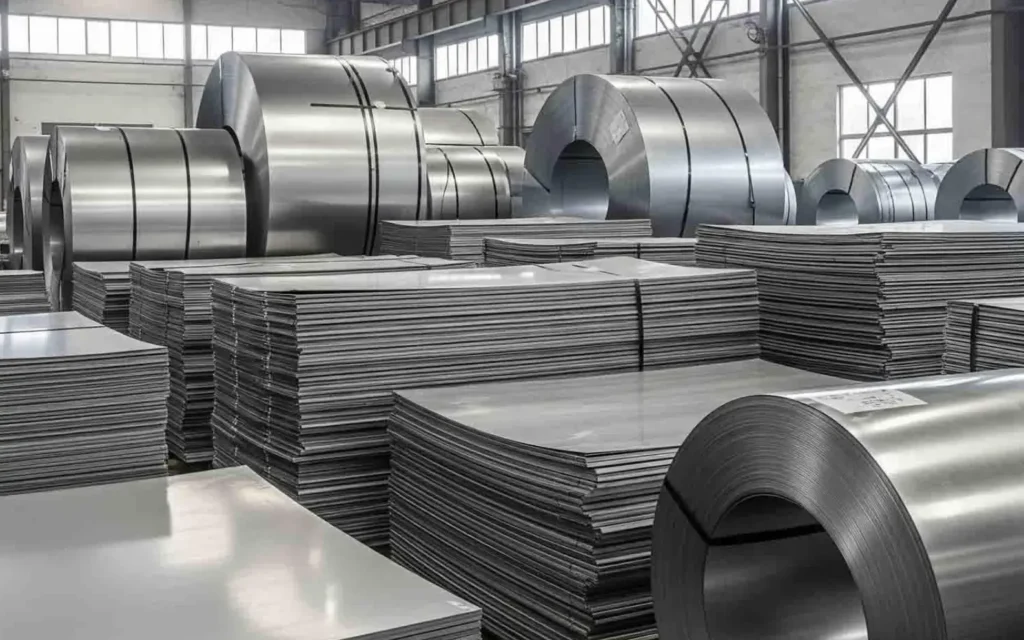
- SS 321 / 321H Sheets, Plates, Coils Overview
- Types of SS 321 / 321H Sheets, Plates, Coils
- SS 321 / 321H Sheets, Plates, Coils Specifications
- SS 321 / 321H Sheets, Plates, Coils Chemical Composition
- SS 321 / 321H Sheets, Plates, Coils Mechanical Properties
- SS 321 / 321H Sheets, Plates, Coils Equivalent Grades
- SS 321 / 321H Sheets, Plates, Coils Applications
- Why Choose Metals Fabrica for SS 321 / 321H Sheets, Plates, Coils?
- SS 321 / 321H Sheets, Plates, Coils FAQs
- Request a Quote for SS 321 / 321H Sheets, Plates, Coils
SS 321 / 321H Sheets, Plates, Coils Overview
Type 321 is an 18-8 austenitic stainless steel stabilised with titanium. In ASTM A240 the titanium content must be at least five times the sum of carbon and nitrogen, up to 0.70%. Titanium forms carbides in preference to chromium, so the steel does not sensitise when welded or when it runs for long periods in the 425–815 °C range that would cause intergranular corrosion in unstabilised 304.
Compared with 304, 321 has a narrower chromium range (17.0–19.0%) and higher nickel (9.0–12.0%). Its main strength is in hot, cycling, welded parts: aircraft and engine exhausts, expansion bellows, heater casings and thermal oxidisers. 321H (UNS S32109) raises carbon to 0.04–0.10% and relaxes the titanium minimum to 4×(C+N), giving the creep strength needed for ASME pressure parts at elevated temperature. Both grades have 515 MPa tensile, 205 MPa yield and 40% elongation minimums in A240.
Titanium carbonitrides make 321 a poor choice for fine polishing, and titanium is partly lost across the arc during welding, so niobium-stabilised 347 plate or 347 filler is often preferred for heavy welded sections. Metals Fabrica supplies 321 and 321H sheet, plate and coil and can quote SS 321 / 321H pipe for the same equipment.
- Standard: ASTM A240 / ASME SA240 Type 321, 321H
- Stabiliser: titanium 5×(C+N) – 0.70% (321); 4×(C+N) – 0.70% (321H)
- Service range: resists sensitisation from about 425 °C to 815 °C
- Hardness: 217 HBW / 95 HRB maximum
Types of SS 321 / 321H Sheets, Plates, Coils
SS 321 Cold Rolled Sheet
2B sheet in thin gauges for exhaust manifolds, heat shields, silencers and ducting that are formed, welded and then run hot.
SS 321 Hot Rolled Plate
Solution-annealed No. 1 plate for heater shells, flue-gas ducting and furnace components that cycle through the sensitising temperature range.
SS 321H Plate
Higher-carbon plate for pressure vessels and headers designed to ASME rules at elevated temperature, where creep strength sets the wall thickness.
SS 321 Strip for Bellows
Precision cold-rolled strip for multi-ply expansion bellows and flexible hoses, combining deep formability with stability at operating temperature.
SS 321 Cut-to-Size Blanks
Plate and sheet cut to drawing sizes or circles for flanges, rings, baffles and covers in high-temperature assemblies.
SS 321 / 321H Sheets, Plates, Coils Specifications
| Specification | Details |
|---|---|
| Standard | ASTM A240 / ASME SA240 Type 321, 321H; general requirements ASTM A480 |
| UNS | S32100 (321), S32109 (321H) |
| Thickness | Sheet 0.3 – 6 mm; plate 6 – 150 mm and above |
| Width | 1000, 1219, 1500, 2000, 2500 mm and to order |
| Length | 2000, 2500, 3000, 6000 mm; coils; cut to size |
| Finish | No. 1, 2D, 2B |
| Forms | Sheet, plate, coil, strip, shim and cut-to-size blanks |
| Edge | Mill edge or slit edge |
| Heat treatment | Solution annealed, rapidly cooled and pickled; stabilising anneal on request |
| Hardness | 217 HBW / 95 HRB maximum |
| Testing | Tensile, hardness; IGC to ASTM A262, PMI with Ti verification, plate UT on request |
| Documentation | EN 10204 3.1 mill test certificate; EN 10204 3.2 on request |
For 321H, confirm the grain size and any ASME code case requirements in your enquiry.
SS 321 / 321H Sheets, Plates, Coils Chemical Composition
| Grade | UNS | C | Mn | Si | P | S | Cr | Ni | Ti | N |
|---|---|---|---|---|---|---|---|---|---|---|
| 321 | S32100 | 0.08 | 2.00 | 0.75 | 0.045 | 0.030 | 17.0 – 19.0 | 9.0 – 12.0 | 5×(C+N) – 0.70 | 0.10 |
| 321H | S32109 | 0.04 – 0.10 | 2.00 | 0.75 | 0.045 | 0.030 | 17.0 – 19.0 | 9.0 – 12.0 | 4×(C+N) – 0.70 | – |
SS 321 / 321H Sheets, Plates, Coils Mechanical Properties
| Grade | Tensile Strength, min | Yield Strength (0.2% Offset), min | Elongation in 50 mm, min | Hardness, max | Density | Melting Range |
|---|---|---|---|---|---|---|
| 321 | 515 MPa (75 ksi) | 205 MPa (30 ksi) | 40% | 217 HBW / 95 HRB | 7.92 g/cm³ | 1400 – 1425 °C |
| 321H | 515 MPa (75 ksi) | 205 MPa (30 ksi) | 40% | 217 HBW / 95 HRB | 7.92 g/cm³ | 1400 – 1425 °C |
Density and melting range are typical values, not A240 requirements.
SS 321 / 321H Sheets, Plates, Coils Equivalent Grades
| Grade | UNS | Werkstoff Nr. | EN | JIS | BS | AFNOR | GOST |
|---|---|---|---|---|---|---|---|
| SS 321 | S32100 | 1.4541 | X6CrNiTi18-10 | SUS 321 | 321S31 | Z6CNT18-10 | 08Х18Н10Т |
| SS 321H | S32109 | 1.4878 | X8CrNiTi18-10 | SUS 321H | 321S51 | – | – |
Equivalents are approximate; 1.4878 is a heat-resisting steel to EN 10095. Order to the standard named in your specification.
SS 321 / 321H Sheets, Plates, Coils Applications
Aircraft and Engine Exhausts
Exhaust collectors, manifolds and heat shields made from thin 321 sheet that is welded and then exposed to repeated heating and cooling.
Expansion Joints and Bellows
Bellows elements and flexible connectors for hot gas and steam lines, where formability and resistance to sensitisation are both needed.
Refinery and Petrochemical Heaters
Heater casings, stack liners, tube supports and convection-section parts operating for long periods in the 425–815 °C range that would sensitise 304.
Thermal Oxidisers and Incinerators
Combustion chambers, ducts and heat-recovery sections handling hot exhaust gas, with intermittent condensation of corrosive species during start-up and shutdown.
Elevated-Temperature Pressure Vessels
321H plate for vessels and headers whose allowable stresses at temperature depend on the creep strength given by its controlled carbon.
Why Choose Metals Fabrica for SS 321 / 321H Sheets, Plates, Coils?
- 321 or 321H confirmed: we check the design temperature and code requirements to see whether your plate needs the H grade.
- Stabilisation on the certificate: Ti, C and N are checked against the A240 ratio for each heat.
- Matching components: sheet and plate quoted with SS 321 / 321H fittings, flanges and bars.
- Documentation support: EN 10204 3.1 certificates, with IGC tests or third-party inspection coordinated when required.
SS 321 / 321H Sheets, Plates, Coils FAQs
What is the difference between 321 and 321H plate?
321H has carbon controlled at 0.04–0.10% instead of 0.08% maximum, and a titanium minimum of 4×(C+N) instead of 5×(C+N). The higher carbon gives better creep strength, so 321H is specified for code pressure parts at elevated temperature.
Should I choose 321 or 347 sheet?
Both are stabilised 18-8 grades with similar corrosion resistance. 321 is common in thin sheet and bellows, while 347 is often preferred for heavy welded sections because niobium is not lost across the welding arc the way titanium is.
Why use 321 instead of 304L at high temperature?
304L resists sensitisation during welding, but long service at 425–815 °C can still precipitate chromium carbides. Titanium in 321 ties up carbon permanently, and 321 also has better strength at temperature than 304L.
Can 321 sheet be polished?
321 can be given 2B or brushed finishes, but titanium carbonitride particles make bright or mirror polishing difficult. Where appearance matters, 304 or 316L is normally used instead.
Request a Quote for SS 321 / 321H Sheets, Plates, Coils
Sheets, Plates & Coils by material
SS Sheets, Plates, Coils grades
- SS Sheets, Plates, Coils
- SS 304 / 304L Sheets, Plates, Coils
- SS 316 / 316L / 316H Sheets, Plates, Coils
- SS 316Ti Sheets, Plates, Coils
- SS 310 / 310S Sheets, Plates, Coils
- SS 317 / 317L Sheets, Plates, Coils
- SS 321 / 321H Sheets, Plates, Coils
- SS 347 / 347H Sheets, Plates, Coils
- SS 410 Sheets, Plates, Coils
- SS 446 Sheets, Plates, Coils
- SS 904L Sheets, Plates, Coils