- Mohammed Ali Road, Mumbai, Maharashtra 400003, India.



SS 347 / 347H Sheets, Plates, Coils Supplier in Mumbai
- Home
- Products
- Sheets, Plates & Coils
- Stainless Steel Sheets, Plates & Coils Supplier in Mumbai
- SS 347 / 347H Sheets, Plates, Coils Supplier in Mumbai
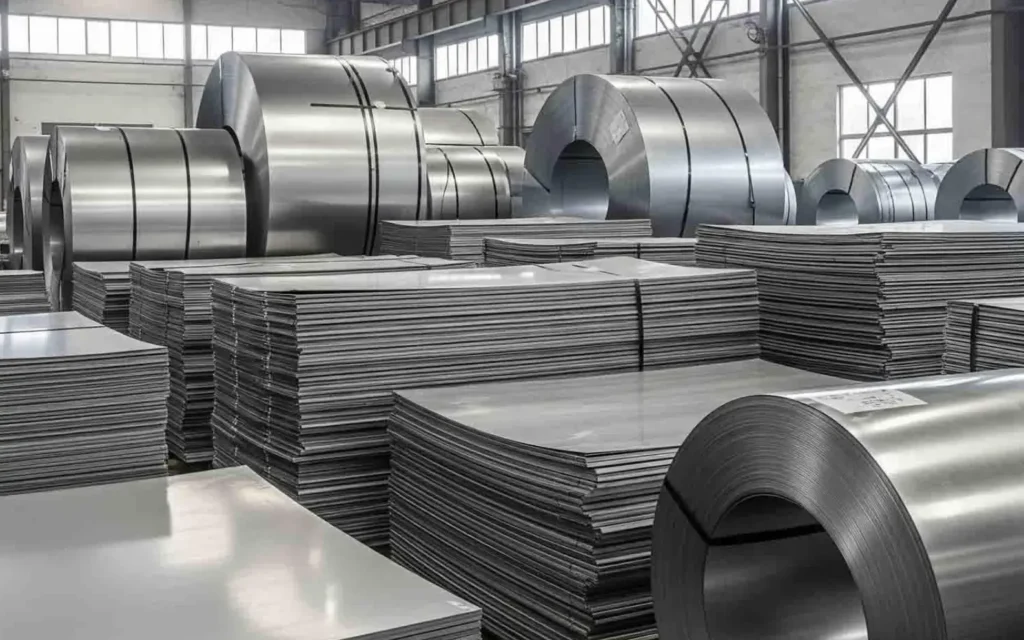
- SS 347 / 347H Sheets, Plates, Coils Overview
- Types of SS 347 / 347H Sheets, Plates, Coils
- SS 347 / 347H Sheets, Plates, Coils Specifications
- SS 347 / 347H Sheets, Plates, Coils Chemical Composition
- SS 347 / 347H Sheets, Plates, Coils Mechanical Properties
- SS 347 / 347H Sheets, Plates, Coils Equivalent Grades
- SS 347 / 347H Sheets, Plates, Coils Applications
- Why Choose Metals Fabrica for SS 347 / 347H Sheets, Plates, Coils?
- SS 347 / 347H Sheets, Plates, Coils FAQs
- Request a Quote for SS 347 / 347H Sheets, Plates, Coils
SS 347 / 347H Sheets, Plates, Coils Overview
Type 347 is an 18-8 austenitic stainless steel stabilised with niobium (columbium). ASTM A240 requires niobium of at least ten times the carbon content, up to 1.00%. Niobium carbides form in preference to chromium carbides, so welded 347 plate resists intergranular corrosion after exposure in the sensitising range, and the grade keeps good strength and oxidation resistance up to about 815 °C.
The practical difference from 321 plate is in welding and heavy sections. Niobium transfers across the arc far better than titanium, so 347 filler is used even on 321, and 347 plate is often chosen for thick reactor and exchanger components in refineries. 347H (UNS S34709) raises carbon to 0.04–0.10% for creep strength, with niobium at 8×C minimum. In A240 both grades share 515 MPa tensile, 205 MPa yield, 40% elongation and a 201 HBW hardness limit, lower than the 217 HBW allowed for 321.
Refinery users also value 347 for its resistance to polythionic acid stress corrosion cracking during shutdowns, especially after a thermal stabilisation treatment. Metals Fabrica supplies 347 and 347H sheet, plate and coil and can quote SS 347 / 347H pipe and SS 347 / 347H bars for the same unit.
- Standard: ASTM A240 / ASME SA240 Type 347, 347H
- Stabiliser: niobium 10×C – 1.00% (347); 8×C – 1.00% (347H)
- Hardness: 201 HBW / 92 HRB maximum
- Typical use: heavy welded sections at elevated temperature
Types of SS 347 / 347H Sheets, Plates, Coils
SS 347 Hot Rolled Plate
Solution-annealed No. 1 plate for reactor internals, exchanger shells and heavy welded parts operating in or passing through the sensitising range.
SS 347H Plate
Controlled-carbon plate for pressure vessels, headers and transfer lines designed to ASME rules at temperatures where creep governs.
SS 347 Cold Rolled Sheet
2B finish sheet for exhaust components, heat shields and thin welded parts where niobium stabilisation is specified instead of titanium.
Stabilisation-Annealed 347 Plate
Plate given an additional stabilising heat treatment, usually around 900 °C, when the purchaser requires maximum resistance to polythionic acid cracking.
SS 347 Coils and Strip
Cold-rolled coil and slit strip for expansion bellows, gaskets and formed parts in high-temperature piping and engine systems.
SS 347 / 347H Sheets, Plates, Coils Specifications
| Specification | Details |
|---|---|
| Standard | ASTM A240 / ASME SA240 Type 347, 347H; general requirements ASTM A480 |
| UNS | S34700 (347), S34709 (347H) |
| Thickness | Sheet 0.3 – 6 mm; plate 6 – 150 mm and above |
| Width | 1000, 1219, 1500, 2000, 2500 mm and to order |
| Length | 2000, 2500, 3000, 6000 mm; coils; cut to size |
| Finish | No. 1, 2D, 2B |
| Forms | Sheet, plate, coil, strip and cut-to-size blanks |
| Edge | Mill edge or slit edge |
| Heat treatment | Solution annealed, rapidly cooled and pickled; stabilising heat treatment on request |
| Hardness | 201 HBW / 92 HRB maximum |
| Testing | Tensile, hardness; IGC to ASTM A262, PMI with Nb verification, plate UT on request |
| Documentation | EN 10204 3.1 mill test certificate; EN 10204 3.2 on request |
State any stabilising heat treatment, grain size or ASME code requirements for 347H in your enquiry.
SS 347 / 347H Sheets, Plates, Coils Chemical Composition
| Grade | UNS | C | Mn | Si | P | S | Cr | Ni | Nb |
|---|---|---|---|---|---|---|---|---|---|
| 347 | S34700 | 0.08 | 2.00 | 0.75 | 0.045 | 0.030 | 17.0 – 19.0 | 9.0 – 13.0 | 10×C – 1.00 |
| 347H | S34709 | 0.04 – 0.10 | 2.00 | 0.75 | 0.045 | 0.030 | 17.0 – 19.0 | 9.0 – 13.0 | 8×C – 1.00 |
SS 347 / 347H Sheets, Plates, Coils Mechanical Properties
| Grade | Tensile Strength, min | Yield Strength (0.2% Offset), min | Elongation in 50 mm, min | Hardness, max | Density | Melting Range |
|---|---|---|---|---|---|---|
| 347 | 515 MPa (75 ksi) | 205 MPa (30 ksi) | 40% | 201 HBW / 92 HRB | 7.96 g/cm³ | 1400 – 1425 °C |
| 347H | 515 MPa (75 ksi) | 205 MPa (30 ksi) | 40% | 201 HBW / 92 HRB | 7.96 g/cm³ | 1400 – 1425 °C |
Density and melting range are typical values, not A240 requirements.
SS 347 / 347H Sheets, Plates, Coils Equivalent Grades
| Grade | UNS | Werkstoff Nr. | EN | JIS | BS | AFNOR | GOST |
|---|---|---|---|---|---|---|---|
| SS 347 | S34700 | 1.4550 | X6CrNiNb18-10 | SUS 347 | 347S31 | Z6CNNb18-10 | 08Х18Н12Б |
| SS 347H | S34709 | 1.4961 | X8CrNiNb16-13 | SUS 347H | 347S51 | – | – |
Equivalents are approximate; 1.4961 has lower chromium than 347H. Order to the standard named in your specification.
SS 347 / 347H Sheets, Plates, Coils Applications
Refinery Hydroprocessing Units
Reactor internals, exchanger shells and piping components in hydrotreaters and hydrocrackers, where polythionic acid cracking during shutdown is a known risk.
High-Temperature Heat Exchangers
Tube sheets, shells and channels for feed-effluent exchangers and process heaters that operate continuously in the sensitising temperature range.
Power Plant Components
347H plate for headers, ducts and boiler parts exposed to steam and flue gas at temperatures where creep strength matters.
Aerospace and Engine Parts
Exhaust rings, collectors and heat shields in niobium-stabilised sheet for welded assemblies that run hot and cycle often.
Chemical Process Vessels
Welded vessels for nitric acid and oxidising media at elevated temperature, where 347 resists intergranular attack in weld zones.
Why Choose Metals Fabrica for SS 347 / 347H Sheets, Plates, Coils?
- Service review: we check whether your design needs 347 or 347H, and whether a stabilising heat treatment or grain size requirement applies.
- Niobium ratio checked: mill certificates are reviewed for Nb against the A240 multiple of carbon.
- Matching components: plate quoted with SS 347 / 347H pipe fittings and pipe in the same grade.
- Documentation support: EN 10204 3.1 certificates, with third-party inspection coordinated when your order requires it.
SS 347 / 347H Sheets, Plates, Coils FAQs
What is the difference between 347 and 321 plate?
347 is stabilised with niobium and 321 with titanium. Niobium is retained better during welding, so 347 is preferred for heavy welded sections and as a filler metal. A240 also sets a lower hardness limit for 347 (201 HBW) than for 321 (217 HBW).
When is 347H required instead of 347?
347H is required for pressure parts whose design relies on elevated-temperature allowable stresses, typically above about 525 °C. Its 0.04–0.10% carbon range gives the creep strength the code assumes.
What is a stabilising heat treatment for 347?
It is an extra anneal, commonly around 900 °C, that encourages niobium carbides to form and leaves less carbon free to combine with chromium. Refiners specify it to improve resistance to polythionic acid stress corrosion cracking.
Is 347 the same as 1.4550?
1.4550 (X6CrNiNb18-10) is the closest European grade to 347 and is often accepted as equivalent. The niobium and nickel limits differ slightly, so certify to the standard named in your specification.
Request a Quote for SS 347 / 347H Sheets, Plates, Coils
Sheets, Plates & Coils by material
SS Sheets, Plates, Coils grades
- SS Sheets, Plates, Coils
- SS 304 / 304L Sheets, Plates, Coils
- SS 316 / 316L / 316H Sheets, Plates, Coils
- SS 316Ti Sheets, Plates, Coils
- SS 310 / 310S Sheets, Plates, Coils
- SS 317 / 317L Sheets, Plates, Coils
- SS 321 / 321H Sheets, Plates, Coils
- SS 347 / 347H Sheets, Plates, Coils
- SS 410 Sheets, Plates, Coils
- SS 446 Sheets, Plates, Coils
- SS 904L Sheets, Plates, Coils