- Mohammed Ali Road, Mumbai, Maharashtra 400003, India.


SS 317 / 317L Sheets, Plates, Coils Supplier in Mumbai
- Home
- Products
- Sheets, Plates & Coils
- Stainless Steel Sheets, Plates & Coils Supplier in Mumbai
- SS 317 / 317L Sheets, Plates, Coils Supplier in Mumbai
- SS 317 / 317L Sheets, Plates, Coils Overview
- Types of SS 317 / 317L Sheets, Plates, Coils
- SS 317 / 317L Sheets, Plates, Coils Specifications
- SS 317 / 317L Sheets, Plates, Coils Chemical Composition
- SS 317 / 317L Sheets, Plates, Coils Mechanical Properties
- SS 317 / 317L Sheets, Plates, Coils Equivalent Grades
- SS 317 / 317L Sheets, Plates, Coils Applications
- Why Choose Metals Fabrica for SS 317 / 317L Sheets, Plates, Coils?
- SS 317 / 317L Sheets, Plates, Coils FAQs
- Request a Quote for SS 317 / 317L Sheets, Plates, Coils
SS 317 / 317L Sheets, Plates, Coils Overview
317 and 317L are austenitic stainless steels with more chromium, nickel and molybdenum than 316. A240 sets chromium at 18.0–20.0%, nickel at 11.0–15.0% and molybdenum at 3.0–4.0%, against 16–18%, 10–14% and 2–3% for 316. The extra molybdenum raises resistance to pitting and crevice corrosion, and the grade performs better in sulphuric acid, acetic acid and the chloride-rich liquors found in bleach plants and scrubbers.
317L (UNS S31703) restricts carbon to 0.030% and is the form almost always specified for welded plate, since it avoids sensitisation in the heat-affected zone. Unusually, A240 gives 317L the same minimum strength as 317 (515 MPa tensile, 205 MPa yield) and a higher minimum elongation, 40% against 35%. Welds should be made with an over-alloyed filler, because molybdenum segregation in the weld metal can otherwise lower its pitting resistance below that of the plate.
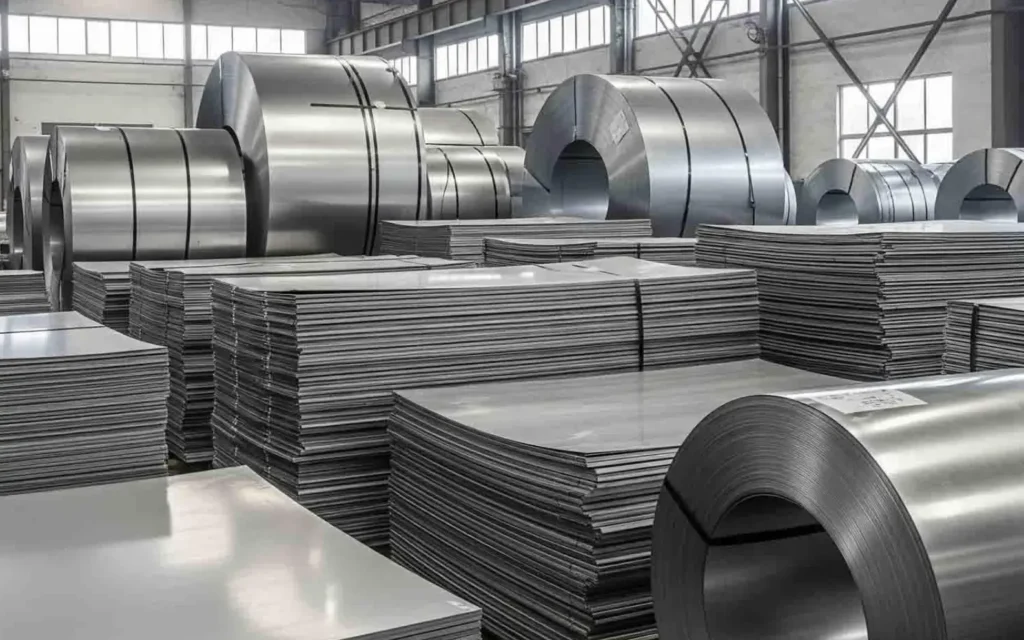
317L sits between 316L plate and super-austenitic 904L plate in cost and corrosion resistance. Metals Fabrica supplies 317 and 317L sheet, plate and coil, and can quote SS 317 / 317L pipe for the same system.
- Standard: ASTM A240 / ASME SA240 Type 317, 317L
- Molybdenum: 3.0–4.0%
- Welding: over-alloyed filler recommended for corrosive service
- Hardness: 217 HBW / 95 HRB maximum
Types of SS 317 / 317L Sheets, Plates, Coils
SS 317L Hot Rolled Plate
Solution-annealed No. 1 plate for absorber shells, digesters and tank walls in welded construction, where low carbon protects the heat-affected zone.
SS 317L Cold Rolled Sheet
2B sheet for ducting, liners and fabricated internals in scrubbers and chemical equipment exposed to acidic, chloride-bearing condensate.
SS 317 Plate
Standard-carbon 317 plate for components that are not welded or are solution annealed after fabrication, where the 0.08% carbon limit is acceptable.
SS 317L Coils and Strip
Coil and slit strip for welded tube manufacture, gaskets and formed parts that need more molybdenum than 316L provides.
SS 317LMN Plate
Higher-nitrogen, higher-molybdenum variant (UNS S31726) listed in A240 for flue-gas desulphurisation where 317L is close to its pitting limit.
SS 317 / 317L Sheets, Plates, Coils Specifications
| Specification | Details |
|---|---|
| Standard | ASTM A240 / ASME SA240 Type 317, 317L; general requirements ASTM A480 |
| UNS | S31700 (317), S31703 (317L) |
| Thickness | Sheet 0.3 – 6 mm; plate 6 – 150 mm and above |
| Width | 1000, 1219, 1500, 2000, 2500 mm and to order |
| Length | 2000, 2500, 3000, 6000 mm; coils; cut to size |
| Finish | No. 1, 2D, 2B, BA, No. 4 |
| Forms | Sheet, plate, coil, strip and cut-to-size blanks |
| Edge | Mill edge or slit edge |
| Heat treatment | Solution annealed, rapidly cooled and pickled |
| Hardness | 217 HBW / 95 HRB maximum |
| Testing | Tensile, hardness; IGC to ASTM A262, pitting test to ASTM G48, PMI on request |
| Documentation | EN 10204 3.1 mill test certificate; EN 10204 3.2 on request |
317 and 317L are produced in fewer heats than 316L; confirm thickness and quantity early in your enquiry.
SS 317 / 317L Sheets, Plates, Coils Chemical Composition
| Grade | UNS | C | Mn | Si | P | S | Cr | Ni | Mo | N |
|---|---|---|---|---|---|---|---|---|---|---|
| 317 | S31700 | 0.08 | 2.00 | 0.75 | 0.045 | 0.030 | 18.0 – 20.0 | 11.0 – 15.0 | 3.0 – 4.0 | 0.10 |
| 317L | S31703 | 0.030 | 2.00 | 0.75 | 0.045 | 0.030 | 18.0 – 20.0 | 11.0 – 15.0 | 3.0 – 4.0 | 0.10 |
SS 317 / 317L Sheets, Plates, Coils Mechanical Properties
| Grade | Tensile Strength, min | Yield Strength (0.2% Offset), min | Elongation in 50 mm, min | Hardness, max | Density | Melting Range |
|---|---|---|---|---|---|---|
| 317 | 515 MPa (75 ksi) | 205 MPa (30 ksi) | 35% | 217 HBW / 95 HRB | 8.0 g/cm³ | 1375 – 1400 °C |
| 317L | 515 MPa (75 ksi) | 205 MPa (30 ksi) | 40% | 217 HBW / 95 HRB | 8.0 g/cm³ | 1375 – 1400 °C |
Density and melting range are typical values, not A240 requirements.
SS 317 / 317L Sheets, Plates, Coils Equivalent Grades
| Grade | UNS | Werkstoff Nr. | EN | JIS | BS | AFNOR | GOST |
|---|---|---|---|---|---|---|---|
| SS 317 | S31700 | – | – | SUS 317 | 317S16 | – | – |
| SS 317L | S31703 | 1.4438 | X2CrNiMo18-15-4 | SUS 317L | 317S12 | Z3CND19-15-04 | – |
Equivalents are approximate; 1.4438 has a higher nickel range than 317L. Order to the standard named in your specification.
SS 317 / 317L Sheets, Plates, Coils Applications
Flue-Gas Desulphurisation
Absorber linings, spray headers, mist eliminators and outlet ducts in coal-fired plant scrubbers, where acidic chloride condensate would pit 316L.
Pulp and Paper Bleach Plants
Washers, towers, mixers and filtrate tanks handling chlorine dioxide and other bleaching chemicals, a long-established use for 317L plate.
Chemical and Petrochemical Process
Vessels and columns for acetic, formic and dilute sulphuric acids, where the extra molybdenum lowers general and localised corrosion rates.
Condensers and Coolers
Tube sheets and water boxes for condensers using brackish or contaminated cooling water that 316L cannot reliably handle.
Textile and Dye Works
Dyeing, scouring and bleaching vessels exposed to hot, acidic and chloride-bearing solutions throughout repeated batch cycles and cleaning.
Why Choose Metals Fabrica for SS 317 / 317L Sheets, Plates, Coils?
- Grade fit checked: we compare 317L with 316L, 904L and duplex against your chloride level, acid and temperature before quoting.
- Certificate review: molybdenum, carbon and hardness on the mill certificate are checked against A240 317L limits.
- Matching components: plate quoted with SS 317 / 317L fittings, flanges and bars.
- Testing coordinated: G48 pitting, IGC and third-party inspection arranged when your order requires them.
SS 317 / 317L Sheets, Plates, Coils FAQs
What is the difference between 317L and 316L plate?
317L contains 3.0–4.0% molybdenum and 18–20% chromium, compared with 2.0–3.0% and 16–18% in 316L. This gives noticeably better resistance to pitting, crevice corrosion and acids such as sulphuric and acetic.
What is the difference between 317 and 317L?
317L limits carbon to 0.030% against 0.08% for 317, which protects welds from intergranular corrosion. Under A240 both have the same 515 MPa tensile and 205 MPa yield minimums, and 317L requires 40% elongation against 35%.
Which filler metal is used for welding 317L plate?
For corrosive service, an over-alloyed filler with higher molybdenum, such as a 904L-type or nickel-base consumable, is commonly used. A matching 317L filler can leave the weld less resistant to pitting than the plate.
When should I choose 904L instead of 317L?
Choose 904L for stronger sulphuric or phosphoric acid, higher chloride levels or higher temperatures. Its 4–5% molybdenum, 23–28% nickel and copper addition provide a wider safety margin, at higher cost.
Request a Quote for SS 317 / 317L Sheets, Plates, Coils
Sheets, Plates & Coils by material
SS Sheets, Plates, Coils grades
- SS Sheets, Plates, Coils
- SS 304 / 304L Sheets, Plates, Coils
- SS 316 / 316L / 316H Sheets, Plates, Coils
- SS 316Ti Sheets, Plates, Coils
- SS 310 / 310S Sheets, Plates, Coils
- SS 317 / 317L Sheets, Plates, Coils
- SS 321 / 321H Sheets, Plates, Coils
- SS 347 / 347H Sheets, Plates, Coils
- SS 410 Sheets, Plates, Coils
- SS 446 Sheets, Plates, Coils
- SS 904L Sheets, Plates, Coils