- Mohammed Ali Road, Mumbai, Maharashtra 400003, India.



ASTM A36 Sheet, Plate & Coil Supplier in Mumbai, India
- Home
- Products
- Sheets, Plates & Coils
- Carbon Steel Sheets, Plates & Coils Supplier in Mumbai, India
- ASTM A36 Sheet, Plate & Coil Supplier in Mumbai, India
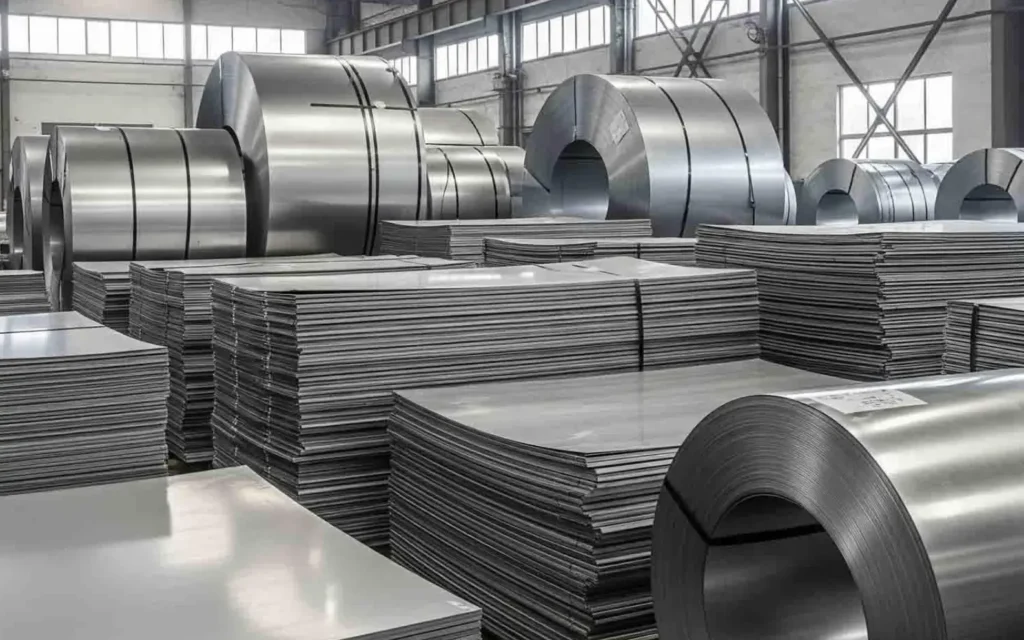
- ASTM A36 Sheet, Plate & Coil Overview
- Types of ASTM A36 Sheet, Plate & Coil
- ASTM A36 Sheet, Plate & Coil Specifications
- ASTM A36 Sheet, Plate & Coil Chemical Composition
- ASTM A36 Sheet, Plate & Coil Mechanical Properties
- ASTM A36 Sheet, Plate & Coil Equivalent Grades
- ASTM A36 Sheet, Plate & Coil Applications
- Why Choose Metals Fabrica for ASTM A36 Sheet, Plate & Coil?
- ASTM A36 Sheet, Plate & Coil FAQs
- Request a Quote for ASTM A36 Sheet, Plate & Coil
ASTM A36 Sheet, Plate & Coil Overview
ASTM A36 is the general-purpose carbon structural steel of North American practice, covering plates, shapes and bars for riveted, bolted and welded construction. It guarantees a minimum yield strength of 250 MPa (36 ksi), from which the grade takes its name, and a tensile range of 400–550 MPa. ASME adopts it as SA36 for supports and non-pressure parts of boilers and vessels.
A36 is a plain carbon-manganese steel with no deliberate microalloying. Its chemistry is graded by thickness: carbon rises from 0.25% in plate up to 20 mm to 0.29% above 100 mm, manganese of 0.80–1.20% is required from 20 mm upward, and plate over 40 mm must be silicon-killed (0.15–0.40% Si). Plate is normally supplied as-rolled. Compared with A283 Grade C it offers higher yield; for 345 MPa designs, A572 Grade 50 is the usual step up.
Choose A36 when the design is governed by stiffness or fabrication rather than strength, or when the drawing names A36 or SA36. It welds readily with standard low-hydrogen practice and is easy to cut, drill and bend. Metals Fabrica supplies A36 plate, sheet and coil and confirms thickness, any copper-bearing requirement and test needs before quoting.
- Standard: ASTM A36 / A36M, ASME SA36; general requirements ASTM A6
- Minimum yield: 250 MPa (36 ksi); 220 MPa for plate over 200 mm
- Condition: as-rolled; normalising not required by the standard
- Copper-bearing option: 0.20% Cu minimum for improved atmospheric corrosion resistance
Types of ASTM A36 Sheet, Plate & Coil
A36 Hot Rolled Plate
Discrete plate from 6 mm upward, rolled and supplied as-rolled to ASTM A6 thickness and flatness tolerances for fabrication shops and structural contractors.
A36 Hot Rolled Coil and Sheet
Thin gauges rolled as coil, then decoiled, levelled and cut to sheet. Pickled and oiled coil is available for forming and painting lines.
A36 Chequered Floor Plate
Raised diamond or lentil pattern plate for platforms, stair treads, trench covers and vehicle floors where slip resistance is needed.
Copper-Bearing A36 Plate
Ordered with 0.20% minimum copper, as allowed by the standard, to slow atmospheric rusting on exposed structures that will not be painted immediately.
A36 / SA36 Dual-Marked Plate
Plate certified to both ASTM A36 and ASME SA36 for support skirts, saddles and lugs welded to pressure equipment.
A36 Cut Blanks and Base Plates
Profile-cut base plates, gussets, stiffeners and flange rings, plasma or gas cut and drilled to your drawing, ready for welding or bolting.
ASTM A36 Sheet, Plate & Coil Specifications
| Specification | Details |
|---|---|
| Standard | ASTM A36 / A36M; ASME SA36 |
| UNS | K02600 |
| General requirements | ASTM A6 / A6M (tolerances, testing, marking) |
| Thickness | Sheet 0.3 – 6 mm; plate 6 – 150 mm and above |
| Width | 1000, 1219, 1500, 2000, 2500 mm and to order |
| Length | 2000, 2500, 3000, 6000 mm; coils and cut to size |
| Delivery condition | As-rolled; normalised on request |
| Surface finish | Hot rolled black, pickled and oiled, shot blasted and primed |
| Forms | Plate, sheet, coil, slit strip, chequered plate, cut blanks |
| Edge | Mill edge or sheared / gas-cut edge; slit edge for strip |
| Testing | Tensile test per A6; ultrasonic testing to ASTM A435 / A578 and Charpy impact as supplementary requirements |
| Documentation | EN 10204 3.1 mill test certificate; EN 10204 3.2 on request |
ASTM A36 strictly covers plate, shapes and bar; thin sheet and coil are commonly certified to A36 properties or to a sheet standard. Confirm which applies in your enquiry.
ASTM A36 Sheet, Plate & Coil Chemical Composition
| Plate thickness | C | Mn | P | S | Si | Cu (when specified) |
|---|---|---|---|---|---|---|
| ≤ 20 mm (¾ in) | 0.25 | – | 0.030 | 0.030 | 0.40 | 0.20 min |
| > 20 to 40 mm | 0.25 | 0.80 – 1.20 | 0.030 | 0.030 | 0.40 | 0.20 min |
| > 40 to 65 mm | 0.26 | 0.80 – 1.20 | 0.030 | 0.030 | 0.15 – 0.40 | 0.20 min |
| > 65 to 100 mm | 0.27 | 0.85 – 1.20 | 0.030 | 0.030 | 0.15 – 0.40 | 0.20 min |
| > 100 mm | 0.29 | 0.85 – 1.20 | 0.030 | 0.030 | 0.15 – 0.40 | 0.20 min |
For each 0.01% reduction below the carbon maximum, a 0.06% increase in manganese above the maximum is permitted, up to the limit in the standard.
ASTM A36 Sheet, Plate & Coil Mechanical Properties
| Plate thickness | Tensile Strength | Yield Strength, min | Elongation in 200 mm, min | Elongation in 50 mm, min |
|---|---|---|---|---|
| ≤ 200 mm | 400 – 550 MPa (58 – 80 ksi) | 250 MPa (36 ksi) | 20% | 23% |
| > 200 mm | 400 – 550 MPa (58 – 80 ksi) | 220 MPa (32 ksi) | 20% | 23% |
For plate wider than 600 mm the elongation requirement is reduced by two percentage points. Density about 7.85 g/cm³ (typical, not a requirement).
ASTM A36 Sheet, Plate & Coil Equivalent Grades
| Grade | UNS | EN | JIS | GB | IS |
|---|---|---|---|---|---|
| ASTM A36 | K02600 | S235JR / S275JR (EN 10025-2) | SS400 | Q235B | IS 2062 E250 |
Equivalents are approximate. S275JR matches A36 more closely in yield, S235JR in chemistry; neither is identical. Order to the standard on your drawing.
ASTM A36 Sheet, Plate & Coil Applications
Building Frames and Connections
Base plates, cap plates, splice plates, gussets and stiffeners in steel-framed buildings, where A36 is the default plate grade in many design codes.
Equipment Supports and Skids
Vessel saddles, skirts, lifting lugs and skid bases, often dual-marked SA36 when they are welded directly to ASME pressure equipment or packaged units.
Pipe Racks and Platforms
Connection plates for pipe racks, chequered walkway plate and stair stringers in refineries, power plants and process units built in structural steel.
Machinery Frames and Bases
Fabricated machine bases, guards, housings and fixtures where stiffness, weldability and ease of machining matter more to the designer than high strength.
Tanks and Bins
Non-pressure hoppers, silos, chutes and water tanks fabricated from A36 plate and sheet, where the contents exert only static or low hydrostatic loads.
Welded Structural Pipe
A36 plate is rolled and welded into large-diameter structural pipe and piling; see LSAW pipe for formed products.
Why Choose Metals Fabrica for ASTM A36 Sheet, Plate & Coil?
- Correct thickness band: we check that certified carbon, manganese and silicon suit the thickness band you are buying.
- A36 or SA36 marking: dual certification confirmed when plate will be welded to ASME equipment.
- Cut sizes and forms: full plates, sheets, chequered plate and profile-cut blanks quoted to your cutting list.
- Matching structural materials: plate can be quoted with LSAW pipe and carbon steel bars for the same project.
- Certificates: EN 10204 3.1 as standard; third-party inspection coordinated when required.
ASTM A36 Sheet, Plate & Coil FAQs
What is the yield strength of ASTM A36 plate?
The minimum yield strength is 250 MPa (36 ksi) for plate up to 200 mm thick and 220 MPa (32 ksi) above that. Tensile strength must fall between 400 and 550 MPa.
What is the difference between A36 and A572 Grade 50?
A572 Grade 50 is a high-strength low-alloy steel with 345 MPa minimum yield, achieved with small additions of niobium, vanadium or titanium. A36 is plain carbon steel with 250 MPa yield. A572 Grade 50 allows lighter sections where strength governs.
Can A36 be used for pressure vessels?
ASME lists SA36 for limited pressure-retaining use and commonly for supports and attachments. Pressure shells are normally specified in A516 or A285, which are pressure-vessel grades with tighter impurity limits and defined heat treatment.
Is A36 the same as IS 2062 E250 or S275JR?
They are comparable structural steels with similar yield strength, but chemistry limits, impact options and thickness bands differ. Substitution needs approval from the designer or the purchaser.
Does A36 plate need impact testing?
ASTM A36 does not require Charpy testing. If the design needs notch toughness, impact tests can be ordered as a supplementary requirement under ASTM A6, or a grade with built-in toughness such as A709 Grade 36 can be specified.
Request a Quote for ASTM A36 Sheet, Plate & Coil
Sheets, Plates & Coils by material
Carbon Steel Sheet, Plate, Coil grades
- Carbon Steel Sheet, Plate, Coil
- ASTM A36 Sheet Plate, Coil
- ASTM A283 Grade C Sheet Plate, Coil
- ASTM A285 Grade C Sheet Plate, Coil
- ASTM A515 Gr 60 Sheet Plate, Coil
- ASTM A515 Gr 70 Sheet Plate, Coil
- ASTM A572 Grade 50 Sheet Plate, Coil
- ASTM A516 Grade 60 Sheet Plate, Coil
- ASTM A516 Grade 65 Sheet Plate, Coil
- ASTM A516 Grade 70 Sheet Plate, Coil
- ASTM A537 Class 2 Sheet Plate, Coil
- ASTM A709 Grade 36 Sheet Plate, Coil
- C45 Sheet Plate, Coil
- IS 2062 E250 / E350 Sheet Plate, Coil